

Requisites
Donald Byrd at The Half Note Café, Volume 1 | By Eddie Carter
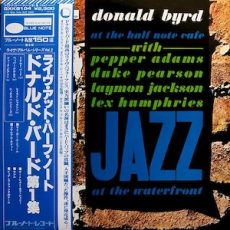
I was still in the mood to hear another trumpet album after listening to Harry “Sweets” Edison when my search led me to another of my Mom’s favorite records. Donald Byrd and Pepper Adams were two musicians she enjoyed listening to and this morning’s record from the library brings them together in a great live date. Donald Byrd at The Half Note Café, Volume 1 (Blue Note BLP 4060/BST 84060) captures the trumpeter’s quintet featuring Pepper Adams (tracks: A1, A2, B2, B3) on baritone sax, Duke Pearson on piano, Laymon Jackson on bass and Lex Humphries on drums in performance at one of New York’s best jazz clubs. This album holds a special place in my heart because it reminds me of the music my Mom and I used to enjoy together during Sunday dinner. My copy is the 1978 King Record Company Japanese Stereo reissue (Blue Note BST 84060 – GXK-8104).
Ruth Mason is our Mistress of Ceremonies for the evening and starts the set with the musician’s introductions. The quintet then launches into the upbeat melody of My Girl Shirl by Duke Pearson. Donald kicks off the solos with an invigorating statement; then Pepper succeeds him with a joyfully spirited solo. Duke emerges next for a brisk presentation, and the front line cooks with Lex ahead of the close. Donald introduces the next tune, his own Soulful Kiddy, a blues that slows the beat down for the ensemble’s marching melody. Pepper serves up some down-home cooking in the opening solo. Donald comes into the second reading with carefree enthusiasm; then Duke eases into the spotlight last, leading to the theme’s restatement and climax.
Side Two opens with Donald’s introduction to A Portrait of Jennie by J. Russel Robinson and Gordon Burdge. The quartet showcase begins with the trumpeter’s romantically warm introduction to the melody. He continues mining a rich vein of sentimentality in the first solo. Duke takes over to deliver a very pretty reading until Donald’s return to add a few more comments into the reprise and close. Cecile by Donald Byrd brings the quintet back for a medium blues that commences with the trio’s introduction to the front line, taking the lead in the melody. Pepper takes off first, cruising at a comfortable pace. Donald gets to work next with an impressive interpretation, and then Duke completes the infectious beat in the finale ahead of the quintet’s closing moments.
The set climaxes with the group’s theme, Pure D. Funk. Donald has the showcase to himself in a concise theme and the song’s only solo into the ensemble’s conclusion. Alfred Lion produced Donald Byrd at The Half Note Café, Volume 1, and Rudy Van Gelder was behind the dials. The reissue has an excellent soundstage transporting the listener to the club audience with excellent fidelity. The unique sound of this album, with its stellar rhythm section and the great chemistry between Donald Byrd and Pepper Adams, is sure to captivate any jazz enthusiast. I invite you to pick up Donald Byrd at The Half Note Café, Volume 1, on your next record shopping trip. It’s a delightful live album that is sure to enjoy repeated plays on the turntable!
Postscript: For those who are unaware, Ruth Mason was a singer and WOV on-air personality who would become Mrs. Alfred Lion. She is also the lovely young woman who appears on the cover of Moods by The Three Sounds.
~ Moods (Blue Note BLP 4044/BST 84044) – Source: Discogs.com © 2024 by Edward Thomas Carter
More Posts: choice,classic,collectible,collector,history,instrumental,jazz,music,trumpet

Daily Dose Of Jazz…
David Silliman was born on July 28, 1960 and raised in the San Francisco, California bay area where he was exposed to a wide variety of music. His first studies were in the classical field, studying snare drum, xylophone and timpani. He was later exposed to Jazz, Latin Jazz, Brazilian and Funk music. His current setup varies from the standard American drum set augmented with a South American cajon, drums from the Middle East, Africa and the Caribbean along with various other percussion instruments.
He hass performed on the stages of European and American jazz festivals, and spent years playing with Blossom Dearie as a member of her trio. He has toured with Al DiMeola, Cassandra Wilson, Leslie Uggams, Mariah Carey, Edmar Castaneda, and performed with Aretha Franklin. He is no stranger to the Broadway pit or the New Jersey Symphony, having sat in the chairs of both.
Drummer and percussionist David Silliman, who has yet to record as a leader, continues to perform.

More Posts: drums,history,instrumental,jazz,music,percussion

Daily Dose Of Jazz…
Charlie Queener was born in Pineville, Kentucky on July 27, 1921 or 1923, the actual year of his birth is in question. During the Forties he worked with the Muggsy Spanier Orchestra, Harry James Orchestra, Benny Goodman Orchestra, Joe Marsala Orchestra, and Glen Gray among others.
Between 1946-50 Queener settled into Nick’s in New York and then spent much of his career freelancing with Dixieland all-stars. Among his associations were Bobby Hackett, Billy Butterfield, Jimmy McPartland, Ruby Braff, Max Kaminsky, Wingy Manone from 1954 to 1960, Wild Bill Davison and with Clarence Hutchenrider on and off from 1958 to 1973, to name a few.
He worked into the 1990s, also composed orchestral works starting in the mid-1960s but never led a record session of his own. Pianist Charlie Queener, who played in Dixieland, swing and mainstream settings, died in July 1997.
More Posts: history,instrumental,jazz,music,piano
Daily Dose Of Jazz…
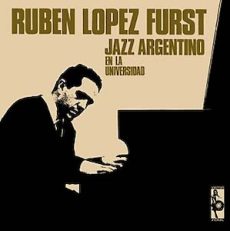
Rubén “Baby” López Fürst was born July 26, 1937 in Buenos Aires, Argentina. From the age of five he studied music and piano, and was soon attracted to jazz. In 1951 the 14 year old Ruben got the nickname Baby from the other musicians because he was a child. He made his debut on the jazz scene performing at the concerts organized by the Hot Club de Buenos Aires.
In 1953 Baby played in a string ensemble led by the López Fürst brothers who performed a jazz concert at the Provincial Hotel in the city of Mar del Plata, Argentina. With his brother Héctor on banjo and him on piano they created the Hot Jammers group and made two 78-single records for Victor. He went on to be part of the Dixie band, The Picking Up Timers.
In 1957 the big succes of Oscar Alemán inspired Baby to leave the piano and take up the guitar, trying to emulate one of his idols: Django Reinhardt. Then began regular performances with a string-group named the Blue Strings. It was a quartet in the vein of gypsy string swing.
Modern jazz captivated him in 1959, when he listened to Gerry Mulligan at the Hot Club de Montevideo in Uruguay. Trying to play those new sounds, in 1962 he joined the modern group of pianist Sergio Mihanovich. On the two albums recorded in 1962, the work began Argentine cool jazz with saxophonist Leandro “Gato” Barbieri, Sergio Mihanovich on piano, drummer Osvaldo “Pichi” Mazzei, trumpeter Rubén Barbieri, Oscar López Ruiz on electric guitar, Rubén López Furst on piano, Domingo Cura on percussion, Osvaldo Bissio vibráphone, and baritone saxophonist Julio Darré.
Fürst is one of the most important pianists in the history of Argentinean jazz and opted to stay in Buenos Aires and make a name for himself at home unlike his counterparts Barbieri and Lalo Schiffrin. He played for over 20 years, mainly with his own trio or quartet.
The hard bop musician also formed a swing group. Pianist and guitarist Baby Fürst, whose primary influences were Teddy Wilson and Bill Evans, died on July 26, 2000 at the age of 63 in Buenos Aires.
More Posts: bandleader,guitar,history,instrumental,jazz,music,piano

Daily Dose Of Jazz…
Denman Maroney was born on July 25, 1949 in Durfort-et-Saint-Martin-de-Sossenac, Occitanie, France. He went on to receive his Bachelor of Arts from William College and his Masters of Fine Arts in composition and piano from the California Instute of the Arts.
He plays what he calls hyperpiano involves stopping, sliding, bowing, plucking, striking and strumming the strings with copper bars, aluminum bowls, rubber blocks, plastic boxes and other household objects. This is sometimes done with one hand while the other hand is used to play the keys.
He received a grant from the National Endowment for the Arts for his work and worked on a new soundtrack to go with German horror film The Cabinet of Dr. Caligari. As an educator he held a position of adjunct professor at Ramapo College of New Jersey in 2010 and is currently at Fairleigh Dickinson University.
Pianist and composer Denman Maroney continues to explore and create music.
More Posts: bandleader,composer,history,instrumental,jazz,music,piano