

Requisites
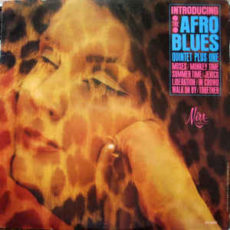
Introducing The Afro Blues Quintet Plus One is a 1965 recording on the Mira label. The photograph and cover design was by George Whiteman, exemplifies a typical 1960s post-exotica style. Active as a photographer-designer during the Sixties, he produced covers for both jazz and blues artists, such as Jimmy Reed and B.B. King.
An obscure album from an obscure Los Angeles, California based jazz combo, the surprise is finding how much it swings. Possible reasons: the youthful exuberance of its then-22-year-old leader and vibraphonist Joe De Aguero, the clever arrangements of standards and pop tunes, and the live recording (though no date or location is given).
Some reasons why, on the other hand, it’s not as good as it could be: a sameness to the arrangements (similar chord changes and runs in both “Liberation” and “Together” really stand out), soloing that never stakes its claim, missed opportunities to really add the “Afro” (read: African percussion) that makes up half of its name. The main ingredient here is a gospel swing that infects “Jericho” as well as an inventive take on “Walk On By.”
Young compiles on this recording the following eight compositions: Moses, Liberation, The Monkey Time, Summertime, Jericho, Walk On By, Together, and The “In” Crowd. Long out of print, this album is worth hunting down. #jazz #classic #collectible #music

More Posts: choice,classic,collectible,collector,history,instrumental,jazz,music,vibraphone
Requisites
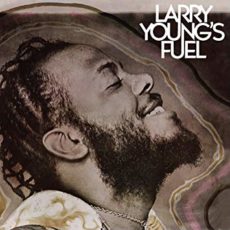
Larry Young’s Fuel is a jazz fusion album by organist/keyboardist Larry Young, recorded and released on the Arista Records label in 1975. The cover photography was provided by Benno Friedman with art direction and design by Bob Heimall.
The composers on the album included Young, Philips, Santiago Torano, Laura Logan and Fernando Saunders. The album is comprised of seven compositions Fuel for the Fire, I Ching (Book of Changes), Turn off the Lights, Floating, H + J = B (Hustle + Jam = Bread), People Do Be Funny and New York Electric Street Music.
The players on this session were: Larry Young – keyboards, Santiago Torano – guitar, Fernando Saunders – bass and background vocals, Rob Gottfried – drums and percussion, and Laura “Tequila” Logan – vocals
More Posts: choice,classic,collectible,collector,history,instrumental,jazz,keyboard,music
Requisites
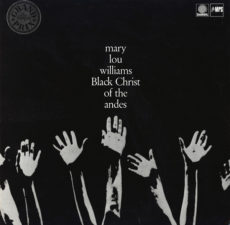
Black Christ of the andes is a 1963 recording from Mary Lou Williams on the MPS label. Photographer Charles “Chuck” Stewart provided the original cover image for designer Gigi Berendt, however, there was a second image provided for the 2004 reissue. In the mid-to-late 1950s, the jazz composer and pianist retired from public performance for nearly four years. During her hiatus she converted to Catholicism, and the first record she made after her return was a marked departure from her previous work: it was a mass.
In 1962, the Catholic Church canonized a new saint: A Peruvian brother of the Dominican Order named Martin de Porres, the son of a freed slave named Ana Velazquez and a Spanish gentleman who refused to recognize him because he was born with his mother’s dark features. St. Martin de Porres was a gifted healer who was dedicated to the poor — today, he is the patron saint of those who seek racial harmony.
The fourteen tracks on the album are St. Martin de Porres, It Ain’t Necessarily So, The Devil, Miss D. D., Anima Christi, A Grand Night For Swinging, My Blue Heaven, Dirge Blues, A Fungus Amungus, Koolbonga, Forty-Five Degree Angle, Nicole, Chunka Lunka and Praise The Lord.
The opening hymn, “St. Martin de Porres,” begins with a choir singing a cappella. The chords — dense and full of satisfying tensions — showcase Williams’ previously underutilized aptitude for vocal arrangement. As they sing the saint’s name, the choir slows down, masterfully swelling on the vowels as if to prove their devotion. When Williams finally enters on the keys, she does so with an Afro-Latin groove, perhaps a nod to the heritage of the hymn’s subject.
Williams, a leading exponent of stride piano, a difficult style of playing similar to ragtime, was developed in New York City’s Harlem during World War I. As one of the most influential women in jazz, she was a mentor to the likes of Charlie Parker and Thelonious Monk.
Mary Lou Williams’ Black Christ of the andes is jazz for the soul and an overlooked choral masterpiece that should be a part of every collection.
More Posts: choice,classic,collectible,collector,history,instrumental,jazz,music,piano
Requisites
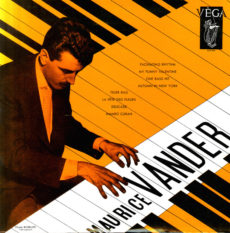
Maurice Vander is the self-titled album recorded in 1955 by Maurice Camille Gustave Vanderschueren, better known as his stage sir name Vander. This bop session was recorded in Paris, France on the Disques Vega label and the cover art/photography was designed by Roberlus Tervueren. The band, unfortunately, is uncredited on this session.
Eight standards were set for this recording session that included Pennies From Heaven, I’ll Remember April, The Nearness Of You, Strike Up The Band, How About You, There’ll Never Be Another You, Everything Happens To Me and Get Happy.
To my dismay and probably to that of others, I can find no audio version of this album and this album is out of print but there are a few used copies on the market that one may be able to claim and make a part of their collection.
More Posts: choice,classic,collectible,collector,history,instrumental,jazz,music,piano
Hollywood On 52nd Street
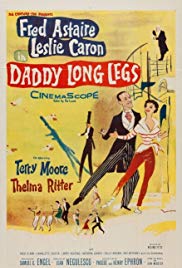
Something’s Gotta Give was composed by Johnny Mercer for his friend Fred Astaire who starred in the 1955 film Daddy Long Legs. It is the love song duet between him and Leslie Caron. The song playfully uses the irresistible force paradox – which asks what happens when an irresistible force meets an immovable object – as a metaphor for a relationship between a vivacious woman and an older, world-weary man. The man, it is implied, will give in to temptation and kiss the woman.
The film also stars Terry Moore, Thelma Ritter, Fred Clark and Ray Anthony who appears as himself with his orchestra. Filming took place on location at 20th Century Fox Studios in Hollywood and the Andrew Carnegie Mansion in Manhattan.
Storyline
On a trip to France, millionaire Jervis Pendleton III (Astaire) sees an 18 year old girl Julie Andre (Caron) in an orphanage. Immediately enchanted with her, but mindful of the difference in their ages and what the press may report should his involvement be discovered, he anonymously sponsors her to attend fictional college in New England. She writes him letters, which he doesn’t read. After 3 years, he goes to visit her at a dance, not telling her that he is her benefactor. They fall in love, but the usual movie-type difficulties get in the way before they can get together at the end.
