Daily Dose Of Jazz…
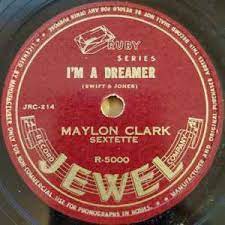
Mahlon Clark was born on March 7, 1923 and raised in Portsmouth, Virginia. He started out in vaudeville as a child, however, as a teenager he became a big band musician playing for the Ray McKinley and Will Bradley bands, among others.
Relocating to California during World War II and after serving in the armed forces, found employment at Paramount Pictures where he performed music on many movie soundtracks.
In 1962 Mahlon was hired by Lawrence Welk to join his orchestra and his television show. For six years he played both the clarinet and saxophone on the weekly show and on stage when the Musical Family went out on tour.
Leaving the Welk organization in 1968, Clark continued to perform on many more movie soundtracks and with numerous artists such as Frank Sinatra and Madonna.
Clarinetist and saxophonist Mahlon Clark transitioned on September 20, 2007 at the age of 84.
More Posts: clarinet,history,instrumental,jazz,music,saxophone
Daily Dose Of Jazz…
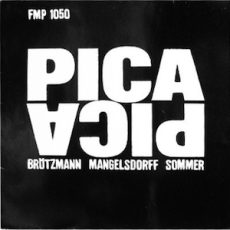
Peter Brötzmann was born on March 6, 1941 in Remscheid, North Rhine-Westphalia, Germany. He studied painting in Wuppertal and was involved with the Fluxus movement but grew dissatisfied with art galleries and exhibitions. He experienced his first jazz concert when he saw Sidney Bechet while still in school at Wuppertal, and it made a lasting impression.
He taught himself to play clarinets, then saxophones and finally the tárogató. Among his first musical partnerships was with double bassist Peter Kowald. His debut recording, For Adolphe Sax, released in 1967 featured Kowald and drummer Sven-Åke Johansson. In 1968 Machine Gun, an octet recording, was released and self-produced under his BRO record label which he sold at concerts. Atavistic reissued the album in 2007.
His 1969 album Nipples, wasn’t followed with another recording as a leader until 1976 which was followed by sixty-one more releases through 2020. Brötzmann was a member of Bennink’s Instant Composers Pool, a collective of musicians who released their own records and that grew into a 10-piece orchestra.
The logistics of touring with the ICP tentet or his octet resulted in Peter reducing the group to a trio with Han Bennink and Fred Van Hove. Bennink was a partner in Schwarzwaldfahrt, an album of duets recorded outside in the Black Forest in 1977 with Bennink drumming on trees and other objects found in the woods.
In 1981, Brötzmann made a radio broadcast with saxophonists Frank Wright and Willem Breuker, trumpeter Toshinori Kondo, trombonists Hannes Bauer and Alan Tomlinson, pianist Alexander von Schlippenbach, drums Louis Moholo, and bassist Harry Miller. This was released as the album Alarm.
During the Eighties, Brötzmann flirted with heavy metal and noise rock, recording with Last Exit and the band’s bass guitarist and producer Bill Laswell. His has released over fifty albums as a bandleader and has appeared on dozens more. His Die Like a Dog Quartet (with Toshinori Kondo, William Parker and drummer Hamid Drake) is loosely inspired by saxophonist Albert Ayler, a prime influence on his music. Since 1997, he has toured and recorded regularly with the Peter Brötzmann Chicago Tentet which he disbanded after an ensemble performance in November 2012 in Strasbourg, France.
He has recorded or performed with Cecil Taylor, Keiji Haino, Willem van Manen, Mats Gustafsson, Ken Vandermark, Conny Bauer, Joe McPhee, Paal Nilssen-Love and Brötzmann’s son, Caspar Brötzmann.
Saxophonist and clarinetist Peter Brötzmann, who has not abandoned his art training and has designed most of his album covers, continues to perform and record.
More Posts: bandleader,clarinet,history,instrumental,jazz,music,saxophone
Daily Dose Of Jazz…
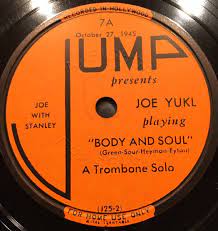
Joseph William Yukl was born on March 5, 1909 in Los Angeles, California and learned to play violin before switching to trombone as a teenager.
Yukl relocated to New York City in 1927 where he took a position playing in radio bands for CBS, and worked with Red Nichols and The Dorsey Brothers. During 1934 he played with Joe Haymes, then with the Dorseys once again.
Through the end of the decade he played with Louis Armstrong, Ray McKinley, Bing Crosby, Ben Pollack, Frankie Trumbauer, and Ted Fio Rito. The 1940s saw Joe working as a session musician for studio recordings in Los Angeles, California and for film and television.
He played with Wingy Manone and Charlie LaVere in the 1940s. He appears in the film Rhythm Inn in 1951 and is heard playing trombone in the 1953 movie The Glenn Miller Story.
Trombonist Joe Yukl transitioned on March 16, 1981 at the age of 72 in his hometown.
More Posts: history,instrumental,jazz,music,trombone

Daily Dose Of Jazz…
Ann Burton was born Johanna Rafalowicz on March 4, 1933 in Amsterdam, Netherlands. When she was 3 years old her mother married a diamond worker and in 1938 her surname was changed to her stepfather’s and she became Johanna de Paauw, which was her official name until 1971, when she again changed it back to Rafalowicz.
During World War II her family faced Jewish persecution under the German occupation and she went into hiding while her mother and stepfather survived the Nazi concentration camps. However, the family became disrupted when her stepparents were deprived of parental power. Johanna, who had Polish nationality, acquired Dutch nationality in 1957.
Johanna never had singing lessons, but she had listened to American singers like Doris Day, Jo Stafford, Rosemary Clooney, Ella Fitzgerald and Sarah Vaughan. Later, Billie Holiday and Shirley Horn influenced her. She wanted to get into the music world and so in about 1955 she took the name Ann Burton inspired by the Welsh actor Richard Burton.
Ann Burton began her career as a singer with a quintet in Luxemburg. She sang with bandleader Johnny Millstonford and performed in clubs with the orchestra of Ted Powder for American soldiers in Germany.
In the summer of 1958 she sang in the quartet of pianist Pia Beck in Scheveningen and in 1960 they toured with saxophonist Piet Noordijk in Spain and Morocco. Returning home she continued singing and in 1965 she made an EP for Decca Records with the nl:Frans Elsen Trio. Later she joined Ramses Shaffy’s group Shaffy Chantant.
The late sixties saw Ann getting noticed by John J. Vis, the director of the record company Artone, who produced her first album Blue Burton in 1967. She became popular and the album received an Edison Award in 1969. A few more records in 1969 and 1972 were released in collaboration with John Vis.
In 1973, she toured Japan, where she became the most popular jazz singer, second only to Ella Fitzgerald. She made numerous albums with Masahiko Sato and Ken McCarthy and others. In the late seventies she worked in New York, where she made several albums, some of which were with Grady Tate and Buster Williams with singer Helen Merrill producing the albums. For “New York State of Mind” Burton also received an Edison award.
In the eighties she founded her own record label, Burtone, that produced her albums. During the period 1986–1988 she taught at the Amsterdam Conservatory.
Vocalist Ann Burton, who recorded twenty-one albums, transitioned at the age of 56 due to throat cancer on November 29, 1989 in Amsterdam.
More Posts: bandleader,history,instrumental,jazz,music,vocal
Daily Dose Of Jazz…
Fernand Coppieters was born in Brussels, Belgium on March 3, 1905. He took up piano in his youth and also played the Hammond organ. His first professional work was with the ensemble Bistrouille ADO in 1920 at age 15. Following this, he played in the Red Mills Ragtime Band and the Rhythmic Novelty Dance Orchestra.
Leaving Belgium for France he landed a place in Fud Candrix’s ensemble in France and Holland. Returning to Brussels in 1929, he played in a trio with René Compère and again with Candrix. Soon after this, he joined the 16 Baker Boys, led by Robert de Kers and, later, Oscar Aleman.
In the early 1930s, he accompanied Josephine Baker on tours of Europe, then worked with Roland Dorsay, Candrix once again, and Willie Lewis. In the 1940s and 1950s, he recorded as a leader and worked as a house pianist for Radio Schaerbeek, an independent Belgian radio station.
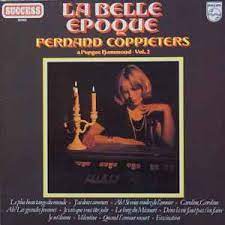
In the late 1950s and 1960s, he recorded several albums on Hammond organ, for Fontana Records and Philips Records. Pianist and organist Fernand Coppieters, who also played accordion, saxophone, and violin, transitioned on September 9, 1981 in Brussels.
More Posts: accordion,bandleader,history,instrumental,jazz,music,organ,piano,saxophone,violin