

Daily Dose Of Jazz…
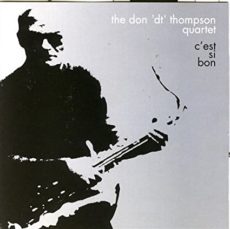
Don D.T. Thompson was born in Drumheller, Alberta on September 19, 1932. He played saxophone and clarinet at twelve and began promoting his own jazz concerts, Jammin’ the Blues, in Edmonton at 17. Moving to Toronto, Canada in 1952, he toured Canada and the United States from 1954 to 1958 with Anne Marie Moss.
Save for a period in 1965 and 1966 with the Lionel Hampton Orchestra in the United States, Thompson was a mainstay of the Toronto jazz scene through the 1960s. During the early 1960s, he led singer Tommy Ambrose in a big band ensemble. He appeared regularly at the First Floor Club with small groups and a big band from 1959 until 1965, and was seen in the NFB’s Toronto Jazz with a quintet.
He performed on many CBC TV pop music shows, Club Six and Music Hop and played in several Toronto studio orchestras. In 1961 he recorded as a member of the Pat Riccio Big Band in Ottawa and 1963 saw him with pianist Wray Downes and trombonist Rob McConnell. He also released a record as part of a quintet that included trumpeter Fred Stone.
After touring for ten years beginning in 1971 and recording with pop singer Anne Murray, he returned to jazz. In 1981 moving away from his early bebop-based style he landed on a simpler, full-toned, melodic approach in the manner of a Stanley Turrentine. D.T. wrote and recorded several jazz themes; his pop-song arrangements appear on albums by Murray, John Allan Cameron and Gordon Lightfoot.
Saxophonist, composer, and arranger Don D.T. Thompson passed away in Vancouver, Canada on March 21, 2004.

More Posts: arranger,composer,history,instrumental,jazz,music,saxophone
Daily Dose Of Jazz…
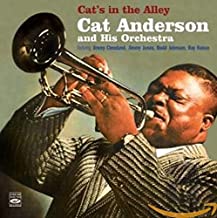
Cat Anderson was born William Alonzo Anderson on September 12, 1916 in Greenville, South Carolina. Losing both parents when he was four years old, he was sent to live at the Jenkins Orphanage in Charleston, South Carolina where he learned to play the trumpet. It was his classmates that gave him the nickname “Cat” based on his fighting style.
He toured and made his first recording with the Carolina Cotton Pickers, a small group based at the orphanage. After leaving the Cotton Pickers, Anderson played with guitarist Hartley Toots, the Claude Hopkins Big Band, Lucky Millinder, the Erskine Hawkins Orchestra, the Sabby Lewis Orchestra, the Lionel Hampton Orchestra, with whom he recorded the classic Flying Home No. 2, and the Doc Wheeler Sunset Orchestra with whom he also recorded from 1938–1942.
His career took off in 1944 when he joined Duke Ellington’s orchestra at the Earle Theater in Philadelphia, Pennsylvania. He quickly became a central part of Ellington’s sound. Although Anderson was a very versatile musician, capable of playing in a number of jazz styles, he is most renowned for his abilities in the extreme high or “altissimo” range. He had a big sound in all registers but could play up to a “triple C” with great power, able to perform his high-note solos without a microphone.
A master of half valve and plunger mute playing, Cat was capable of filling in for anyone else who was not there. He led and fronted his own big band and in addition, he was a very skilled arranger and composer. He performed his own compositions El Gato and Bluejean Beguine with Ellington, and others of his compositions and arrangements with his own band, for example on his 1959 Mercury recording, Cat on a Hot Tin Horn.
After 1971, he settled in the Los Angeles, California area, where he continued to play studio sessions, perform with local small and big bands, and to tour Europe. He recorded seven albums as a leader, and as a sideman recorded sixty-four with Johnny Hodges, Quincy Jones, Rosemary Clooney, Frances Faye, Mel Torme, Earl Hines, Bell Berry, Benny Carter, Claude Bolling, Gene Ammons, Louis Bellson, Duke Ellington, Ella Fitzgerald, and Lionel Hampton. Trumpeter Cat Anderson passed away from cancer on April 29, 1981.
More Posts: arranger,bandleader,composer,history,instrumental,jazz,music,trumpet
Daily Dose Of Jazz…
Harry Percy South was born on September 7, 1929 in Fulham, London, England. Coming into prominence in the 1950s, he subsequently performed with Joe Harriott, Dizzy Reece, Tony Crombie, and Tubby Hayes. In 1954, he was in the Tony Crombie Orchestra, together with Dizzy Reece, Les Condon, Joe Temperley, Sammy Walker, Lennie Dawes, and Ashley Kozak.
After returning from a nine-month stint in Calcutta, India, with the Ashley Kozak Quartet, he spent four years with the Dick Morrissey Quartet, where he both wrote and arranged material for their subsequent four albums.
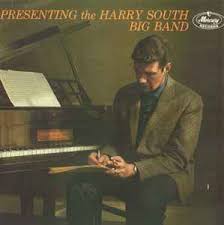
Forming his own jazz big band in 1966, featuring UK musicians Hayes, Dick Morrissey, Phil Seamen, Keith Christie, Ronnie Scott, and Ian Carr, and recorded an album for Mercury Records. In the mid-1960s, he began working with British rhythm & blues singer and organist Georgie Fame, with whom he recorded the album Sound Venture. At that time he was also composing and arranging for Humphrey Lyttelton, Buddy Rich, Sarah Vaughan, and Jimmy Witherspoon.
Working for a time as the musical director to Annie Ross, Harry later branched out into session work, writing themes for television and music libraries, and having written the scores for the Pete Walker films, he is also credited with the arrangements for Emerson, Lake & Palmer, again arranged for Annie Ross and Georgie Fame in collaboration on what was to be Hoagy Carmichael’s last recording, In Hoagland.
Pianist, composer, and arranger Harry South, who was honored with the CD Portraits ~ The Music of Harry South released by the National Youth Jazz Orchestra, passed away on March 12, 1990 in Lambeth, London at age 60.
More Posts: arranger,bandleader,composer,history,instrumental,jazz,music,piano

Daily Dose Of Jazz…
Jan Savitt was born Jacob Savetnick on September 4, 1907 in Shumsk, U.S.S.R. (now Ukraine) and reared in Philadelphia, Pennsylvania. He exhibited musical ability at an early age and began winning conservatory scholarships in the study of the violin. He was offered the position of concertmaster in Leopold Stokowski’s Philadelphia Symphony Orchestra, but turned it down, preferring to continue his studies at Curtis Institute. A year later, believing himself ready, he joined Stokowski and the association continued for seven years, during which time Savitt gained further laurels as a concert soloist and leader of a string quartet.
In 1938, Jan Savitt & His Top Hatters broadcast from 5–5:30 pm every Tuesday, thru Friday as the KYW staff orchestra at KYW/NBC in Philadelphia. Saturday’s weekly broadcast was one hour, coast-to-coast. The group also played at the Earl Theatre and performed with The Andrews Sisters and The Three Stooges.
He got his start in popular music sometime later as music director of KYW, Philadelphia, where he evolved the unique “shuffle rhythm” which remained his trademark. Numerous sustaining programs created such a demand for the “shuffle rhythm” that Savitt left KYW to form his own dance crew.
His band was notable for including George “Bon Bon” Tunnell,[3] one of the first Black singers to perform with a white band. Tunnell’s recording with Jan included Vol Vistu Gaily Star, co-composed by Slim Gaillard, and Rose of the Rio Grande. Helen Englert Blaum, known at the time as Helen Warren, also sang with him during the war years.
In the 1940s Savitt recorded short pieces used a filler before network shows for the National Broadcasting System’s Thesaurus series. Some of the pieces he created were I’m Afraid the Masquerade Is Over; If I Didn’t Care; Ring Dem Bells; and Romance Runs in the Family.
Violinist, bandleader and arranger Jan Savitt, known as “The Stokowski of Swing” from having played violin in Leopold Stokowski’s orchestra, passed away on October 4, 1948.
More Posts: arranger,bandleader,history,instrumental,jazz,music,violin
Daily Dose Of Jazz…
Edwin James Costa was born on August 14, 1930 in Atlas, Pennsylvania, near Mount Carmel, in Northumberland County. He was taught and influenced on piano by his older, musically trained brother, Bill, and a local piano teacher. He took paid jobs as a pianist from the age of 15, and in contrast to his piano training, he was self-taught on vibes.
In 1949 he played and toured for a few months with violinist Joe Venuti. He then worked for his brother in New York until 1951, when Eddie was drafted into the army. During this time in the armed forces, he performed in Japan and Korea. After his discharge, he returned home and worked around the New York area, including for bands led by Kai Winding, Johnny Smith, and Don Elliott.
n 1957 he was chosen as Down Beat jazz critics’ new star on piano and vibes – the first time that one artist won two categories in the same year. He became known for his percussive, driving piano style that concentrated on the lower octaves of the keyboard.
Costa had an eight-year recording career, during which he appeared on more than 100 albums, with five of them were under his own leadership. As a sideman, he appeared in orchestras led by Manny Albam, Gil Evans, Woody Herman, and others; played in smaller groups led by musicians including Tal Farlow, Coleman Hawkins, Gunther Schuller, and Phil Woods; and accompanied vocalists including Tony Bennett and Chris Connor. Costa died, aged 31, in a car accident in New York City.
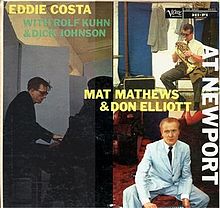
His first recording as a leader was in 1956, with his trio featuring bassist Vinnie Burke and drummer Nick Stabulas. Around this time, he was nicknamed The Bear by Burke for his powerful playing. He and Burke joined Tal Farlow and became the resident trio at the Composer Club. In 1957 Costa was again leader, recording Eddie Costa Quintet with Woods, Art Farmer, Teddy Kotick, and Paul Motian. He would go on to record 1958’s Guys and Dolls Like Vibes with Bill Evans, Wendell Marshall, and Motian.
Late at night on July 28, 1962, pianist, vibraphonist, composer, and arranger Eddie Costa passed away in a car crash, involving no other vehicles, on New York’s Westside Highway at 72nd Street in New York City.

More Posts: arranger,composer,history,instrumental,jazz,music,piano,vibraphone