

Daily Dose Of Jazz…
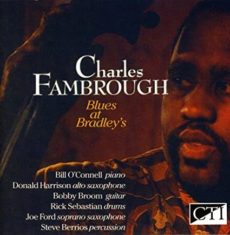
Charles Fambrough was born on August 25, 1950 in Philadelphia, Pennsylvania. He originally studied classical piano but switched to bass when he was 13. In 1968, he began playing with local pit bands for musicals and after some freelancing in 1970, he joined Grover Washington, Jr.’s band, staying with him until 1974.
Moving on he worked with Airto from 1975 to 1977), followed by McCoy Tyner for two years in 1978 and then on to be a part of the Jazz Messengers under Art Blakey from 1980 to 1982. Leaving the Messengers Charles freelanced as a sideman and led three CTI recordings with Wynton and Branford Marsalis, Roy Hargrove, Kenny Kirkland, Jerry Gonzalez, Steve Turre, Donald Harrison, Kenny Garrett, Abdullah Ibrahim, Grover Washington, Jr., Jeff “Tain” Watts, Stephen Scott, Billy Drummond, Bobby Broom, and Steve Berrios.
As a sideman, he worked and recorded sixteen albums with Kei Akagi, Craig Handy, Eric Mintel, and Roland Kirk among others. Reportedly been suffering from a number of serious ailments including end-stage renal disease and congestive heart failure, and benefit concerts had been held over the preceding several years in the Philadelphia area to help the bassist and his family defray the costs of his mounting medical bills.
Bassist, composer, and bandleader Charles Fambrough passed away at the age of 60 of a heart attack at his home in Allentown, Pennsylvania on January 1, 2011.

More Posts: bandleader,bass,composer,history,instrumental,jazz,music
Daily Dose Of Jazz…
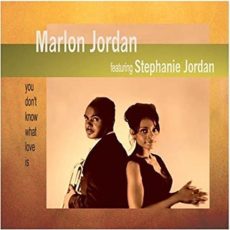
Marlon Jordan was born August 21, 1970 in New Orleans, Louisiana, one of six performers of a prominent family of New Orleans musicians. He is the son of saxophonist Edward “Kidd” Jordan and classical pianist Edvidge Jordan, and his brother Kent is a flutist, his sister Rachel is a violinist, and sister Stephanie is a jazz singer.
Starting on playing trumpet in the fourth grade, he graduated from the famed New Orleans Center for the Creative Arts. A major influence was Wynton Marsalis and Terence Blanchard who he knew when he was a child. Marlon recorded as a sideman with his brother Kent in 1987 and Dennis González in 1988.
In 1988 at age 18 he recorded his debut album as a leader, For You Only, with Branford Marsalis, brother Kent, and Elton Heron. Taking his quintet on the road, with Wynton Marsalis, Miles Davis and George Benson, he was billed as one of the headlining act in a series of JVC Jazz Festival dates. They would go on to play some of the country’s top jazz clubs, as well as in concerts.
He has recorded with his immediate family, Stephanie, Edward, Rachel, Kent, along with uncle Alvin Batiste, cousin Jonathan Bloom, uncle Maynard Chatters, and Chatters’ son, Mark.
In 2005, Marlon and sister Stephanie toured Bucharest, Germany, Lithuania and Ukraine as Jazz Ambassadors on a European Tour as part of the Higher Ground Relief effort sponsored by the U.S. Department of State, and Jazz at Lincoln Center to thank the people of Europe for their support of New Orleans and the Gulf region following Hurricane Katrina. Trumpeter, composer and bandleader Marlon Jordan continues to perform, record, and tour.
More Posts: bandleader,composer,history,instrumental,jazz,music,trumpet

Daily Dose Of Jazz…
Perry Morris Robinson was born on September 17, 1938, the son of composer Earl Robinson. He grew up in New York City and attended the Lenox School of Jazz in Massachusetts in the summer of 1959. After serving in a U.S. military band in the early 1960s, his first record, Funk Dumpling with Kenny Barron, Henry Grimes, and Paul Motian was recorded by Savoy in 1962.
He would go on to record with Grimes on The Call in 1965, in which two of the album’s six songs are credited to Robinson, including the title track. From 1973, he worked with Jeanne Lee and Gunter Hampel’s Galaxie Dream Band. He contributed to Dave Brubeck’ s Two Generations of Brubeck and played with Burton Greene’ s Dutch klezmer band Klezmokum. He was the featured clarinetist on Archie Shepp’s LP Mama Too Tight on the Impulse! label.
Perry led his own groups in performances and on record, with albums on the Chiaroscuro, WestWind, and Timescraper labels. More recently, he worked with William Parker and Walter Perkins on Bob’s Pink Cadillac and several other discs on the CIMP label.
From 1975 until 1977, Robinson was a member of the Clarinet Contrast group, then recorded with Lou Grassi, Wayne Lopes, and Luke Faust in The Jug Jam, an improvisational jug band. He regularly plays and records in a free jazz and world music trio; played with Darius Brubeck and Muruga Booker in the MBR jazz trio, and played an integral part in the formation of the improvisational Cosmic Legends. In 2005 he was featured on his cousin Jeffrey Lewis’ album City and Eastern Songs on Rough Trade Records, A later release was OrthoFunkOlogy in 2008 with the band Free Funk. Clarinetist and composer Perry Robinson, whose autobiography, Perry Robinson: The Traveler was published in 2002, passed away on December 2, 2008.
More Posts: bandleader,clarinet,composer,history,instrumental,jazz,music
Daily Dose Of Jazz…
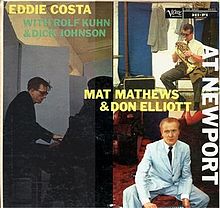
Edwin James Costa was born on August 14, 1930 in Atlas, Pennsylvania, near Mount Carmel, in Northumberland County. He was taught and influenced on piano by his older, musically trained brother, Bill, and a local piano teacher. He took paid jobs as a pianist from the age of 15, and in contrast to his piano training, he was self-taught on vibes.
In 1949 he played and toured for a few months with violinist Joe Venuti. He then worked for his brother in New York until 1951, when Eddie was drafted into the army. During this time in the armed forces, he performed in Japan and Korea. After his discharge, he returned home and worked around the New York area, including for bands led by Kai Winding, Johnny Smith, and Don Elliott.
n 1957 he was chosen as Down Beat jazz critics’ new star on piano and vibes – the first time that one artist won two categories in the same year. He became known for his percussive, driving piano style that concentrated on the lower octaves of the keyboard.
Costa had an eight-year recording career, during which he appeared on more than 100 albums, with five of them were under his own leadership. As a sideman, he appeared in orchestras led by Manny Albam, Gil Evans, Woody Herman, and others; played in smaller groups led by musicians including Tal Farlow, Coleman Hawkins, Gunther Schuller, and Phil Woods; and accompanied vocalists including Tony Bennett and Chris Connor. Costa died, aged 31, in a car accident in New York City.
His first recording as a leader was in 1956, with his trio featuring bassist Vinnie Burke and drummer Nick Stabulas. Around this time, he was nicknamed The Bear by Burke for his powerful playing. He and Burke joined Tal Farlow and became the resident trio at the Composer Club. In 1957 Costa was again leader, recording Eddie Costa Quintet with Woods, Art Farmer, Teddy Kotick, and Paul Motian. He would go on to record 1958’s Guys and Dolls Like Vibes with Bill Evans, Wendell Marshall, and Motian.
Late at night on July 28, 1962, pianist, vibraphonist, composer, and arranger Eddie Costa passed away in a car crash, involving no other vehicles, on New York’s Westside Highway at 72nd Street in New York City.
More Posts: arranger,composer,history,instrumental,jazz,music,piano,vibraphone
Daily Dose Of Jazz…
Lorenzo Paesani was born on August 9, 1977 in Teramo, Abruzzo, Italy and studied piano since childhood. He graduated Summa Cum Laude at 21 from the Niccolò Piccinni Conservatory of Bari. He studied improvisational music all over Europe and the U.S. with John Taylor, Fabrizio Puglisi, Franco D’Andrea, Ralph Alessi, Tim Berne, Marc Ducret, among others.
He collaborated with Norma Winston, Massimo Manzi, Claudio Fasoli, Sound Sketches Orchestra, Sidma Jazz Orchestra, and the Turin Philharmonic Orchestra among others.
Since 2014 he has performed at a variety of jazz festivals across Europe, recorded with different ensembles but all projects have a particular blend of jazz, original compositions and open improvisation, spanning from modern jazz to contemporary music. In his role as a composer, he collaborates with Kairostudio, a cultural association that produces documentaries and movies about the safeguard of the environment. Pianist and bandleader Lorenzo Paesani continues to perform, record and explore the realm of music
More Posts: bandleader,composer,history,instrumental,jazz,music,piano