

The Quarantined Jazz Voyager
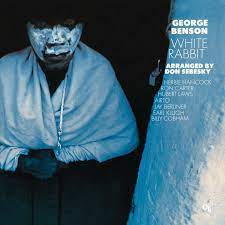
As the Delta variant cases are increasing and vaccinations have leveled out masking and social distancing remain the modus operandi of the day. In my continuation of revisiting albums I have in my collection. So this week I turn to George Benson and his 1972 recording White Rabbit. It was recorded on November 23, 24 & 30, 1971 at Van Gelder Studio in Englewood Cliffs, New Jersey. The album was produced by Creed Taylor, engineered by Rudy Van Gelder and Don Sebesky did all the arrangements. The album cover was designed by Bob Ciano and the cover photography was taken by Pete Turner. The original cover photo was of a Pondo tribe woman that he photographed in South Africa in 1970.
Don Sebesky brought the title track to Taylor and Benson’s attention as Benson had never heard of Jefferson Airplane or Grace Slick. However, Benson doesn’t read music, he just heard the song and automatically fell into the groove, proving that music doesn’t exist on the page, only in the air. White Rabbit was his second CTI Records project and his first Grammy Award nomination in the category of Best Jazz Performance by a Group. This continues to be one of my road trip albums.
Track Listing | 36:18- White Rabbit (Grace Slick) ~ 6:55
- Theme From Summer Of ‘42 ( Michel Legrand) ~ 5:08
- Little Train | from Bachianas Brasileiras (Heitor Villa~Lobos) ~ 5:47
- California Dreamin’ (John Phillips, MIchelle Phillips) ~ 7:22
- El Mar | The Sea (George Benson) ~ 10:49
- George Benson ~ guitar
- Jay Berliner ~ Spanish guitar
- Earl Klugh ~ acoustic guitar (5)
- Herbie Hancock ~ electric piano
- Ron Carter ~ electric bass (1, 3), double bass (2, 4, 5)
- Billy Cobham ~ drums
- Airto Moreira ~ percussion, vocals
- Phil Kraus ~ vibraphone, percussion
- Gloria Agostini ~ harp
- Phil Bodner ~ flute, alto flute, oboe, english horn
- Hubert Laws ~ flute, alto flute, piccolo, flute solo (1)
- George Marge ~ flute, alto flute, clarinet, oboe, English horn
- Romeo Penque ~ english horn, oboe, alto flute, clarinet, bass clarinet
- Jane Taylor ~ bassoon
- Wayne Andre ~ trombone, baritone horn
- Jim Buffington ~ french horn
- John Frosk ~ trumpet, flugelhorn, trumpet solo (1, 5)
- Alan Rubin ~ rumpet, flugelhorn

More Posts: adventure,album,club,genius,jazz,museum,music,preserving,restaurant,travel
Daily Dose Of Jazz…
Albert Laurence Di Meola was born July 22, 1954 in Jersey City, New Jersey and grew up in Bergenfield, New Jersey where he got his education through high school. When he was eight years old, he was inspired by Elvis Presley and the Ventures to start playing guitar. His teacher directed him toward jazz standards.
Attending Berklee College of Music in the early 1970s, by nineteen he was hired by Chick Corea to replace Bill Connors in the pioneering jazz fusion band Return to Forever with Stanley Clarke and Lenny White. He recorded three albums with the band, all of which cracked the Top 40 U.S. Billboard pop albums chart. After the group disbanded in 1976, Al set out on a solo recording career demonstrating his mastery of jazz fusion, flamenco, and Mediterranean music.
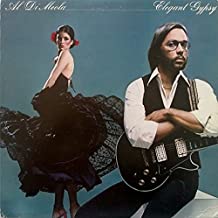
His debut solo album Land of the Midnight Sun in 1976 led to his follow-up His 1977 sophomore album Elegant Gypsy that went gold. His early albums were influential among rock and jazz guitarists. He went on to explore Latin music within jazz fusion, the electronic side of jazz, and along with Jan Hammer and Jeff Beck composed the Miami Vice theme.
Throughout his career he explored his acoustic side, world music and modern Latin styles in addition to jazz and rediscovering his love of the electric guitar in 2006, In 2018, Di Meola was awarded an honorary doctorate of music from his alma mater, Berklee College of Music.
Guitarist Al Di Meola, who cites his jazz influences as guitarists George Benson, Kenny Burrell, Clarence White and Doc Watson, continues to push the envelope with his music.

More Posts: bandleader,composer,guitar,history,instrumental,jazz,music
Daily Dose Of Jazz…
Kay Star was born Catherine Laverne Starks on July 21, 1922 on a reservation in Dougherty, Oklahoma, to an Iroquois Native American father and an Irish/Native American mother. The family moved to Dallas when her father got a job at the Automatic Sprinkler Company,and herer mother raised chickens, whom the young girl serenaded in the coop. When her aunt Nora heard her 7-year-old niece she arranged for her to sing on a Dallas radio station, WRR. Finishing 3rd one week in a talent contest, she placed first every week thereafter. When given a 15-minute radio show, she sang pop and country songs and by age 10 she was making $3 a night during the Great Depression.
The family moved to Memphis, Tennessee where she continued performing on the radio singing Western swing music and a mix of country and pop. While working for Memphis radio station WMPS, misspellings in her fan mail inspired her and her parents to change her name to “Kay Starr”.
By the age of 15, she was singing with the Joe Venuti Orchestra, then went on to work with Bob Crosby and Glenn Miller, who hired her to replace the ill Marion Hutton. After finishing high school, she moved to Los Angeles, California and signed with Wingy Manone’s band. In 1943 she sang with Charlie Barnet’s ensemble, retiring for a year after contracting pneumonia and later developing nodes on her vocal cords as a result of fatigue and overwork.
By 1946 Starr had a solo career and a year later signed a contract with Capitol Records, who also had Peggy Lee, Ella Mae Morse, Jo Stafford, and Margaret Whiting on their roster. In 1948 with a union strike she was left with old songs no of the female singers wanted to record.
In 1950 Kay returned home, heard a recording of Bonaparte’s Retreatby fiddler Pee Wee King. Contacting Roy Acuff’s publishing house in Nashville, got his permission to record the song, he wrote some lyrics and it became her bigget hit selling close to a million in sales. Signing with RCA Victor Records she hit the top ten with My Heart Reminds Me, then returned to Capitol and most of her songs had jazz influences.
After leaving Capitol for a second time in 1966, Starr continued touring the US and the UK, recorded several jazz and country albums on small independent labels including How About This, a 1968 album with Count Basie. By the late Eighties she performed in the revue 3 Girls with Helen O’Connell and Margaret Whiting, and in 1993 she toured the United Kingdom as part of Pat Boone’s April Love Tour. Her first live album, Live at Freddy’s, was released in 1997 and she sang with Tony Bennett on his album Playin’ with My Friends: Bennett Sings the Blues.
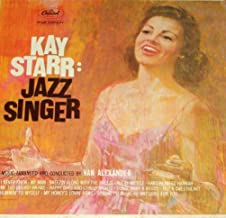
Vocalist Kay Starr, who recorded thirty~six albums, passed away from complications of Alzheimer’s disease on November 3, 2016 in Los Angeles at the age of 94. On June 25, 2019, The New York Times Magazine listed her among hundreds of artists whose material was reportedly destroyed in the 2008 Universal fire.
More Posts: bandleader,history,instrumental,jazz,music,vocal
Three Wishes
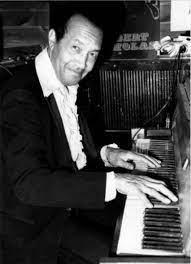
Sir Charles Thompson had but one thing to say in response NIca’s inquiry:
1. “To have you and be able to command you as a king! And be happy together, doing everything we want to do, forever.”
*Excerpt from Three Wishes: An Intimate Look at Jazz Greats ~ Compiled and Photographed by Pannonica de Koenigswarter

More Posts: baroness,history,instrumental,jazz,music,pannonica,piano,three,wishes
Daily Dose Of Jazz…
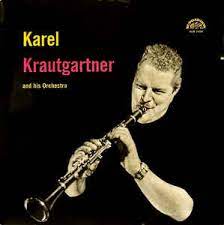
Karel Krautgartner was born on July 20, 1922 in Mikulov, Moravia into the family of a postmaster. He began studying clarinet on a private basis with Stanislav Krtička, and performed a demanding part of the Concertino by Leoš Janáček at the composer’s request at the festival of contemporary music in Frankfurt am Main, Germany in 1926. Acquiring the necessary skills of clarinet playing, and a fanatic passion for clarinet construction and components – reeds, mouthpieces, and barrels, which he later used his knowledge of wind instruments as a lecturer at German universities in Cologne and Düsseldorf.
In 1930 he began playing piano and by 1935 after moving to Brno, Czech Republic he became interested mainly in jazz radio broadcasts. 1936 saw Karel founding the student orchestra Quick band. In 1942, he signed his first professional contract as a saxophonist in the Gustav Brom orchestra in the hotel Passage in Brno. A year later he created Dixie Club and started to arrange in the Benny Goodman and Glenn Miller styles. From 1945 – 1955, the core of the Dixie Club moved to Prague and became a part of the Karel Vlach Orchestra.
He achieved a privileged position as the leader of the saxophone section and started to contribute with his own compositions. In 1956,along with Karel Velebný he put together the Karel Krautgartner Quintet, performed with the All Star Band, and with Studio 5. During the Sixties he became the head of the Dance Orchestra of Czechoslovakia Radio, renamed the Karel Krautgartner Orchestra. In 1968 he emigrated to Vienna, Austria and became the chief conductor of the 0RF Bigband. He eventually moved to Cologne, Germany. Clarinetist, saxophonist, arranger, composer, conductor and educator Karel Krautgartner passed away on September 20, 1982.
More Posts: arranger,clarinet,composer,conductor,educator,history,instrumental,jazz,music,saxophone