

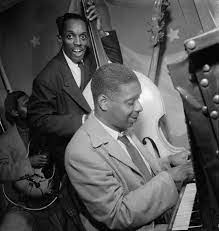
Three Wishes
When the Baroness asked Jimmy Jones if he had the opportunity to get three wishes granted what would they be he responded with:
- “I’d like to be a better musician.”
- “Communicate my music.”
- “To hit a golf ball straight.”
*Excerpt from Three Wishes: An Intimate Look at Jazz Greats ~ Compiled and Photographed by Pannonica de Koenigswarter

More Posts: bandleader,history,instrumental,jazz,music,piano
Daily Dose Of Jazz…
Don Murray was born on June 7, 1904 in Joliet, Illinois and attended high school in Chicago, Illinois. In his teens he made a name for himself as one of the best young jazz clarinetists and saxophonists in the city. In 1923 he recorded with the New Orleans Rhythm Kings and though he was not a regular member of the band, he was a friend who sometimes sat in with them.
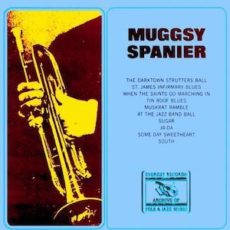
Murray made early recordings with Muggsy Spanier before joining the Detroit, Michigan based band of Jean Goldkette, with whom he remained until 1927. It was here that he mentored the young Jimmy Dorsey.
After a brief stint with Adrian Rollini’s band, during which he contributed to several highly regarded recordings by Bix Beiderbecke, he was hired by Ted Lewis. He can be heard in the 1929 Ted Lewis film Is Everybody Happy?
>Suffering injuries sustained in a freak automobile accident where Don was standing on the running board of a moving roadster and fell, striking the back of his head on the pavement. Immediately hospitalized with serious head injury, clarinetist and saxophonist Don Murray transitioned at the age of 24 on June 2, 1929 in Los Angeles, California.

More Posts: clarinet,history,instrumental,jazz,music,saxophone
Daily Dose Of Jazz…
David Matthews was born on June 6, 1911 in Chagrin Falls, Ohio but was raised in McAlester, Oklahoma. He attended the University of Oklahoma and Chicago College of Music.
He started out as an alto saxophonist with Ben Pollack in 1935, moved to Jimmy Dorsey then Benny Goodman through the rest of the decade. In the Forties Dave went on to play with Harry James, Hal McIntyre, then switched to tenor saxophone with Woody Herman, Stan Kenton and Charlie Barnet.
Matthews arranged for many of these groups, and continued working as an arranger in New York City and California well into the 1960s, with Duke Ellington among others. Occasionally he played with his own bands, including at Lake Tahoe in the 1970s.
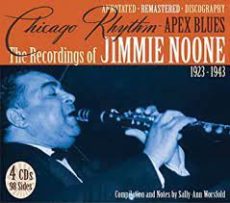
He made recordings with the big bands of Bud Freeman, Lionel Hampton, Jimmy Noone, Jack Teagarden, and Hot Lips Page. Saxophonist Dave Matthews, who was principally playing in the swing era, transitioned in 1997.
More Posts: bandleader,history,instrumental,jazz,music,saxophone
Requisites
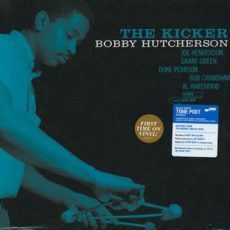
The Kicker ~ Bobby Hutcherson | By Eddie Carter
In 1963, vibraphonist Bobby Hutcherson recorded his first album as a leader which was supposed to be his debut on Blue Note. Sadly, it wasn’t released, and the session remained in the vaults for thirty-six years until it hit the stores in 1999 as a CD album. The Kicker (Blue Note BST 21437), this morning’s choice from the library submitted for your inspection reunites the musicians that recorded Idle Moments by Grant Green six weeks earlier in November. Joe Henderson on tenor sax, Duke Pearson on piano, Grant Green on guitar (tracks: A3 to B2), Bob Cranshaw on bass, and Al Harewood on drums. My copy used in this report is the 2020 Blue Note Tone Poet Series Stereo audiophile reissue.
Side One commences with Mirrors by Joe Chambers, a very pretty song beginning with a brief introduction by Duke opening the way for Hutcherson and the rhythm section’s delicately gentle theme supported by Henderson. Bobby starts with a stunning showcase that’s intimately passionate and very moving. Joe continues expressing deep feelings on the second statement ahead of the ensemble’s thoughtfully polite ending. For Duke P. Bobby’s swinging dedication to Duke Pearson takes off with a brisk opening chorus in unison. Hutcherson gets right down to business on the first interpretation with a spirited reading. Henderson gets into a vibrant workout next and Pearson swings into the closer confidently before the ensemble reprise and close.
The Kicker by Joe Henderson brings Grant Green to the group with an effervescent opening chorus led by the composer. Henderson begins this swinging affair with a swiftly paced solo, then Bobby launches into the next reading vigorously. Grant brings a lot of joy to the third statement and Duke finds some invigorating things to say ahead of the closing chorus and quick climax. Side Two starts with Henderson’s, Step Lightly, an easygoing blues that the ensemble gets underway with a collectively calm theme. Pearson starts the opening solo with easy, unhurried strokes. Hutcherson is smooth as velvet on the second statement. Green swings with a light, refreshing beat next and Henderson provides a fitting summation with a soulful groove preceding the sextet’s ending theme disappearing into a slow fade.
Bedouin by Duke Pearson possesses a Middle Eastern flavor that begins at a snappier tempo than Duke recorded a year later on Wahoo! The solo order is Joe, Grant, Bobby, and Duke, and each gives charming, articulate performances into an ending theme that dissolves into emptiness. The Kicker was originally produced by Alfred Lion and recorded by Rudy Van Gelder. Joe Harley supervised this reissue, and Kevin Gray did the remastering. The sound quality is outstanding with a breathtaking soundstage. The front and rear covers are high-quality with stunning gatefold photos. The vinyl is 180-gram and incredibly quiet until the music starts. If you enjoy good vibes and are looking for a perfect album to enjoy after a long day or week, I highly recommend and offer for a spot in your library, The Kicker by Bobby Hutcherson. It’s a wonderful companion to Idle Moments that’ll reward its owner with many hours of listening pleasure!
~ Idle Moments (Blue Note BLP 4154/BST 84154), The Kicker (Blue Note Connoisseur Series 7243 5 21437 2 6), Wahoo! (Blue Note BLP 4191/BST 84191) – Source: Discogs.com © 2022 by Edward Thomas Carter
More Posts: choice,classic,collectible,collector,history,instrumental,jazz,music,vibraphone
Daily Dose Of Jazz…
Erica Lindsay was born June 5, 1955 in San Francisco, California to parents who were both teachers and lived in Europe in the 1960s. She began her studies in composition with Mal Waldron in Munich, Germany when she was fifteen years old. She played clarinet, then alto and tenor saxophone. In 1973, she spent a year of study at the Berklee School of Music in Boston, Massachusetts and then went back to Europe, where she began her music career. She formed a local quartet and went on tour. Since 1980, she has lived in New York.
As a saxophonist she has worked with Melba Liston, Clifford Jordan, Dizzy Gillespie, McCoy Tyner, Reggie Workman, George Gruntz, and Pheeroan akLaff. Lindsay composed for theater, television, and dance productions and worked with poets and performance artists such as Carl Hancock Rux, Janice King, Janine Vega, Mikhail Horowitz and Nancy Ostrovsky. She leads her own quartet and is the co-leader of a quartet with Sumi Tonooka.
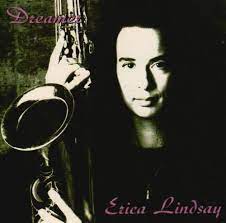
Erica’s 1989 debut album Dreamer was released on Candid Records, with contributions from Robin Eubanks, Howard Johnson, Francesca Tanksley, and Anthony Cox. The 1990s and 2000s saw her playing with Oliver Lake, Baikida Carroll, Howard Johnson, Jeff Siegel, Thurman Barker and the band Trace Elements. Their album Yes – Live at the Rosendale Cafe appeared in 2008.
Saxophonist Erica Lindsay is co-founder of the Artists Recording Collective recording label, a visiting Assistant Professor at Bard College and continues to perform and record.
More Posts: bandleader,educator,history,instrumental,jazz,music,saxophone