

Daily Dose Of Jazz…
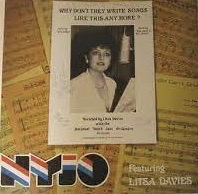
Litsa Jane Davies was born on June 27, 1963 in Hampshire, England. Growing up in Poole, Dorset, she attended Harry Harbin school where her music teacher recognized her vocal talent. At 14 she was singing with him on jazz gigs and appeared locally on television in 1977. By 1979 she was gigging with pianist Mike Hatchard and the following year began a six-year stint with the National Youth Jazz Orchestra. While with NYJO she sang on three albums, notably Why Don’t They Write Songs Like This Anymore?, which featured her throughout.
She performs with her own quintet and has toured with the European Jazz Orchestra. She has sung on radio with the BBC Big Band, the bands Night Owls and Bone Structure as well as her own group. During the early and mid-80s Litsa played festivals with her quintet, and sang with the Burch Trio and saxophonist Iain Ballamy. The following year she joined the cast of the London West End musical Chess at the Prince Edward Theatre going on to play the lead until the show closed in 1989. She continued to sing on BBC radio.
In 1990 Davies concentrated on raising her children while singing backup for Tom Jones and performing with various bands including the Ian Pearce Big Band, the Ross Mitchell Dance Orchestra and the Mark Graham Dance Band. By 1995 she reappeared with a week-long engagement at Ronnie Scott’s club.
Vocalist Litsa Davies, gifted with fine interpretative skills and intelligent phrasing, continues to deliver ballads and up-tempo songs with swing.

More Posts: bandleader,history,instrumental,jazz,music,vocal
Requisites
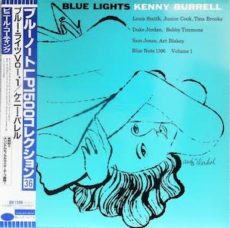
Blue Lights, Volume 1 ~ Kenny Burrell | By Eddie Carter
I became a fan of guitarist Kenny Burrell at an early age, enjoying him on Houseparty (1958), The Sermon (1959), Midnight Special (1961), Back At The Chicken Shack (1963), Organ Grinder’s Swing (1965), All Day Long, and All Night Long (1957), and Steamin’ (1963). He steps into the spotlight this morning with a superb 1958 album, Blue Lights, Volume 1 (Blue Note BLP 1596/BST 81596). It’s a straight-ahead blowing session anchored by a superlative supporting cast, Louis Smith on trumpet, Tina Brooks, Junior Cook (tracks: A1, A2, B2) on tenor sax, Duke Jordan (tracks: A1, A2), Bobby Timmons (tracks: B1, B2) on piano, Sam Jones on bass, and Art Blakey on drums. My copy used in this report is the 1996 Toshiba-EMI Limited Japanese Mono reissue sharing the original catalog number.
Side One begins with Yes Baby, an easy-going blues by Kenny Burrell. The sextet’s relaxing melody gets things off to a good start. Kenny goes to work first with a solo as smooth as satin, then Tina comes in for a deliciously mellow statement. Louis takes a carefree drive next, followed by Junior and Duke who gather good notes during their turns. Sam delivers the payoff by walking leisurely into the ensemble’s slow fading closing chorus. Scotch Blues by Duke Jordan gives the group an extremely fun tune to play with a Scottish flavor in the opening and ending theme. The solo order is Burrell, Brooks, Smith, Cook, Jordan, and Blakey. Each musician develops their readings cheerfully sustained by the rhythm section’s infectiously laid-back vibe.
Autumn In New York by Vernon Duke starts Side Two offering Burrell in a quartet setting with Bobby Timmons taking over the piano duties. Kenny begins with a brief solo introduction that evolves into the ensemble’s attractive melody. Burrell is the song’s only soloist and presents a beautifully elegant reading ahead of the quartet’s thoughtfully polite ending. The album concludes with Caravan, an uptempo swinger by Duke Ellington, Irving Mills, and Juan Tizol. It begins briskly with the opening chorus. Smith is off to the races quickly, then Cook and Brooks follow with two examples of splendid solo work. Burrell simply sizzles on the next reading ahead of Timmons’ fingers flying over the keys. Blakey has the last word preceding the sextet’s reprise and disappearance in a fadeout.
Blue Lights, Volume 1 was produced by Alfred Lion and Rudy Van Gelder was the recording engineer. Toshiba-EMI Limited has done a wonderful job with this reissue’s remastering. The soundstage is stunning, and the musicians jump out of your speakers as if they’re playing in front of you. The vinyl is also flat and silent until the music starts. Kenny Burrell is one of those rare musicians who play with a distinctive blend of explosive and punchy rhythms. His discography as a leader and sideman is extensive and his career has lasted seven decades. Here, he’s completely at ease and perfectly at home playing the blues. If you’re a fan of jazz guitar and only know his album, Midnight Blue, I invite you to check out Blue Lights, Volume 1 by Kenny Burrell. It’s an album of great jazz that doesn’t disappoint, and I’ve already added its companion, Blue Lights, Volume 2 to my Want and Wishlist!
~ All Day Long (Prestige PRLP 7081/PRST 7277), All Night Long (Prestige PRLP 7073/PRST 7289), Back At The Chicken Shack (Blue Note BLP 4117/BST 84117), Blue Lights, Volume 2 (Blue Note BLP 1597/BST 81597), Houseparty (Blue Note BLP 4002/BST 84002), Midnight Blue (Blue Note BLP 4123/BST 84123), Midnight Special (Blue Note BLP 4078/BST 84078), Organ Grinder’s Swing (Verve Records V-8628/V6-8628), Steamin’ (Prestige PRLP 7278/PRST 7278), The Sermon (Blue Note BLP 4011/BST 84011) – Source: Discogs.com ~ Autumn In New York, Caravan – Source: Discogs.com © 2022 by Edward Thomas Carter
More Posts: choice,classic,collectible,collector,guitar,history,instrumental,jazz,music
Daily Dose Of Jazz…
James Archibald McLin was born in Brooksville, Florida on June 26, 1908. He started on piano before picking up the banjo, then later the guitar. He played locally in Florida before relocating to New York City in 1928. He played both guitar and banjo in the early 1930s for James P. Johnson, Ward Pinkett, and Roy Eldridge.
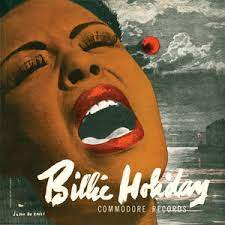
Later in the decade he recorded with Willie “The Lion” Smith, Buster Bailey, Midge Williams, and Billie Holiday. In the early 1940s he worked with Sidney Bechet, Dave Nelson, and Claude Hopkins, then played trombone and mellophone in a military band while serving in the United States Navy during World War II. After his discharge he worked again with Hopkins and played guitar for The Ink Spots.
Banjoist and guitarist Jimmy McLin transitioned on December 15, 1983 in St. Petersburg, Florida.
Daily Dose Of Jazz…
Eddie Blair was born into a musical family in Johnstone, Renfrewshire, Scotland on June 25, 1927. His father played cornet and violin and as the ten year old took after his father picking up the cornet. Playing with the Johnstone Silver Band gave him the musical grounding that facilitated dance band work before he joined the Royal Signals in 1945.
After demobilization in 1948 Blair attended Glasgow College of Technology, playing with jazz and dance bands in the evenings. He got his first brief taste of London, England with the Ken Mackintosh Band before returning to college. By 1951 his work with Mackintosh and Glasgow pianist George Scott Henderson, whose quintet won the runner-up 1949 Melody Maker ‘All Britain’ contest, had come to the notice of Johnny Dankworth, who invited Blair to replace the Germany-bound Deuchar.
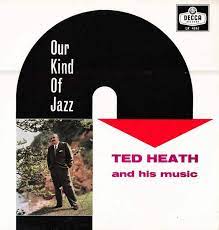
After four years with Dankworth’s Seven and Orchestra, Eddie joined Ted Heath for 11 years, recording regularly and touring the US in 1956 but also recording with Johnny Keating, the Swinging Scots big band, Vic Lewis, Tubby Hayes, Stan Tracey and Ronnie Scott.
Along with Jimmy Deuchar and Aberdonian Bobby Pratt they formed the all-Scottish trumpet section on Hayes’ Jazz for Moderns and his absolute dependability made him a natural for session work. TV programs including The Avengers, Jimmy Rushing, Sacha Distel, blues band Savoy Brown and Mike Oldfield’s sister, Sally all figured in his performing and subsequent session recordings.
At sixty-five in 1992, he retired to concentrate on skiing and golf. Trumpeter Eddie Blair, who in the late 1940s and 1950s became absorbed into the London jazz scene and whose style influenced Deuchar and Kenny Wheeler, transitioned on Boxer Day, December 26, 2020 at age 93 in Rustington, West Sussex, England.
More Posts: history,instrumental,jazz,music,trumpet
Daily Dose Of Jazz…
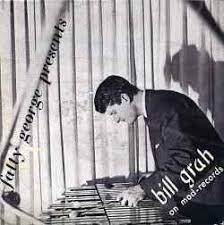
Wilhelm Josef Grah was born on June 24, 1928 in Bergisch-Gladbach, Germany. He led his own quintet from 1949 to 1953, then performed and recorded with Fatty George 1954-1959. I
During the 1960s he moved to Austria where he hosted a radio show in Vienna. He officially became a citizen in 1970. In the 1970s he played with the Austrian Barrelhouse Jazz Band and also led his own quintet.
Pianist and vibraphonist, who led a trio, quintet, sextet, big band and orchestra, transitioned on September 17, 1996 in Vienna.
More Posts: bandleader,history,instrumental,jazz,music,piano,vibraphone