

Daily Dose Of Jazz…
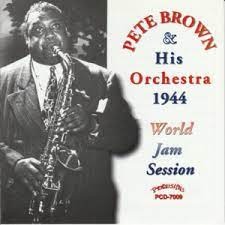
James Ostend Brown was born on November 9, 1906 in Baltimore, Maryland and learned to play piano, trumpet, and saxophone in his youth. Professionally known as Pete Brown, he played in New York City with Bernie Robinson’s orchestra in 1928, and played from 1928 to 1934 with Charlie Skeete.
1937 saw him working in the John Kirby band for several years and during the decade he worked with Frankie Newton, who was also a member of Kirby’s band. Brown and Newton recorded often. In addition to recording under his own name, he also recorded with Willie “The Lion” Smith, Jimmie Noone, Buster Bailey, Leonard Feather, Joe Marsala, and Maxine Sullivan.
Pete worked on 52nd Street in New York City in the 1940s, both as a sideman with Slim Gaillard, among others. As a bandleader, he was in Allen Eager’s 52nd Street All-Stars in 1946.
In the 1950s, Brown’s health began to fail, and he receded from full-time performance. He played with Joe Wilder, Big Joe Turner, Sammy Price, and Champion Jack Dupree. He appeared at the 1957 Newport Jazz Festival with Coleman Hawkins and Roy Eldridge. His last appearance was in 1960 with Dizzy Gillespie.
Alto saxophonist and bandleader Pete Brown, who was Cecil Payne and Flip Phillips teacher, transitioned on September 20, 1963 in New York City.

More Posts: bandleader,history,instrumental,jazz,music,saxophone
Daily Dose Of Jazz…
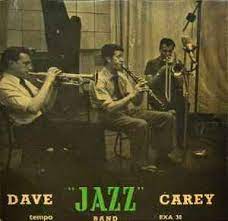
David Arthur Carey was born November 8, 1914 in Coulsdon, Surrey, England. His father was a pianist. In the early Thirties he had his own band that performed in the Croydon borough of London. After the start of World War II he opened a music shop in Streatham before being drafted into military service. In 1946 he opened The Swing Shop in Streatham, where he sold musical instruments and records and which he expanded into a mail order business.
He also played in dance and jazz bands in 1947 with Rex Stewart, who was visiting England, with whom he also recorded in London in September 1949, and in 1948 with Graeme Bell’s Australian Jazz Band. In the same year, Carey took part in recordings by Humphrey Lyttelton for Wilco, in 1950 with the boogie-woogie pianist Roy Vaughan. He was in Lyttleton’s band for a year in 1948 until he was replaced by Bernard Saward. The mid-1950s Dave led his own traditional jazz formations and recorded a number of records for Tempo Records and Decca Records.
Carey performed at the Royal Festival Hall in 1957 and contributed to pianist Pat Hawes’ recordings for Tempo. He worked as a music historian, collaborating with Albert McCarthy and the six-volume work Jazz Directory spanning 1949 to 1952. In the Sixties he led his own band in the 1960s.
According to his colleague Pat Hawes, his drumming was influenced by Baby Dodds, but also by drummers of the swing era such as Gene Krupa, Cozy Cole and George Wettling.
Drummer, bandleader and jazz researcher Dave Carey, who also plays vibraphone and washboard, transitioned on July 18 , 1999 in Croydon.
More Posts: bandleader,drums,history,instrumental,jazz,music,researcher,vibraphone
Jazz Poems
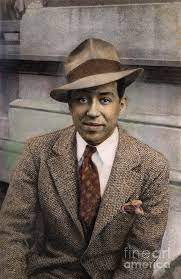
Jazz Band In A Parisian Cabaret Play that thing, Jazz band! Play it for the lords and ladies, For the dukes and counts, For the whores and gigolos, For the American millionaires, And the school teachers Out for a spree. Play it, Jazz band! You know that tune That laughs and cries at the same time. You know it. May I? Mais oui. Mein Gott! Parece una rumba. Play it, jazz band! You’ve got seven languages to speak in And then some, Even if you do come from Georgia. Can I go home wid yuh, sweetie?Sure.
LANGSTON HUGHESfrom Jazz Poems ~ Selected and Edited by Kevin Young

More Posts: book,classic,collectible,history,jazz,library,poet
Daily Dose Of Jazz…
Jan Bertil Allan was born November 7, 1934 in Falun, Sweden and began his career in 1951 as a pianist. After moving to Stockholm, Sweden he changed to the trumpet as his main instrument. At this time he played in Carl-Henrik Norin’s orchestra. In 1954 he worked with Lars Gullin and Rolf Billberg for a year followed by a four year residency starting in 1955 with Carl-Henrik Norin, shlie earning a PhD in physics.
He is considered among the most important modern jazz musicians in Sweden, despite his small number of records. For the first three years in the Sixties he led a quintet with Billberg. Throughout the decade Allan worked with Arne Domnérus, Georg Riedel, and Bengt Hallberg, among others. From 1968 to 1975, he was a member of the Swedish Radio Jazz Group.
His album Jan Allan-70, which featured Rolf Ericson, Nils Lindberg, Bobo Stenson, Jon Christensen, and Rune Gustafsson, won a Grammis Award for Jazz of the Year in 1970. His album Software, released in 1998, stands in strong affinity with the West Coast Jazz of Gerry Mulligan and Stan Getz.
Over the course of his career, he recorded albums with Alice Babs, Bosse Broberg, Benny Carter, Dorothy Donegan, Lars Gullin, Jan Johansson, Thad Jones, Roger Kellaway, Lee Konitz, Nils Lindberg, Georg Riedel, George Russell and Monica Zetterlund among others.
In 2009, he was honored with a Swedish Golden Django as a Master of Jazz. Trumpeter and composer Jan Allan, who recorded eight albums as a leader and composed for several films, continues to perform and compose.
Confer a dose of a Falun trumpeter to those seeking a greater insight about the musicians around the world who are members of the pantheon of jazz…
Jan Allan: 1934 | Trumpet, Composer
More Posts: bandleader,composer,history,instrumental,jazz,music,trumpet
Daily Dose Of Jazz…
Albert “Andy” Gibson was born on November 6, 1913 in Zanesville, Ohio. He played violin early on before settling on trumpet. He played professionally in many orchestras and though he did not solo, he worked more often as an arranger.
During the 1930s his associations include Lew Redman, Zack Whyte, McKinney’s Cotton Pickers, Blanche Calloway, Willie Bryant, and Lucky Millinder. He quit playing in 1937 to arrange and compose full-time, working with Duke Ellington, Count Basie, Cab Calloway, Charlie Barnet, and Harry James. in the United States Army he led a big band while serving from 1942-45.
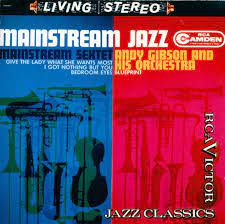
After his discharge, he continued working with Barnet but turned his focus primarily on R&B music. He was musical director for King Records from 1955–60 and recorded four songs as a leader in 1959 which were released by RCA Camden. He composed I Left My Baby popularized by Count Basie, The Great Lie, and The Hucklebuck.
Trumpeter, arranger, and composer Andy Gibson transitioned from a heart attack on February 11, 1961 in Cincinnati, Ohio.
More Posts: arranger,bandleader,composer,history,instrumental,jazz,music,trumpet