

Daily Dose Of Jazz…
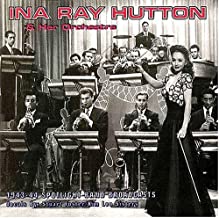
Ina Ray Hutton was born Odessa Cowan on March 13, 1916 in Chicago, Illinois into a family whose mother was a pianist. She began dancing and singing on stage professionally at the age of eight. By 15, she starred in the Gus Edwards revue Future Stars Troupe at the Palace Theater, and Lew Leslie’s Clowns in Clover. On Broadway she performed in George White’s revues Melody, Never Had an Education and Scandals, before joining the Ziegfeld Follies.
1934 saw her being approached by Irving Mills and vaudeville agent Alex Hyde to lead an all-girl orchestra, the Melodears. As part of the group’s formation, Mills asked Odessa to change her name. The group included trumpeter Frances Klein, Canadian pianist Ruth Lowe Sandler, saxophonist Jane Cullum, guitarist Marian Gange, trumpeter Mardell “Owen” Winstead, and trombonist Alyse Wells.
The Melodears appeared in short films and in the movie Big Broadcast of 1936. They recorded six songs, sung by Hutton, before disbanding in 1939. Soon after, she started the Ina Ray Hutton Orchestra (with men only) that included George Paxton and Hal Schaefer. The band appeared in the film Ever Since Venus in 1944, recorded for Elite and Okeh, and performed on the radio. After this band broke up, she started another male band a couple years later. During the 1950s, Hutton again led a female big band that played on television and starred on The Ina Ray Hutton Show.
Although she and some members of her family are known to have been white, historians have theorized that she and her family were of mixed white and African-American ancestry. In 1920, Hutton herself was listed in the US Census as “mulatto” and in 1930 as “negro”. Hutton was also mentioned under her original name in the black Chicago newspaper The Chicago Defender several times in articles describing the early years of her career. A photograph of her as a 7-year-old dancer appeared in a 1924 issue of the paper.
Retiring from music in 1968, Ina Ray Hutton, who led one of the first all-female big bands, passed away on February 19, 1984 from complications due to diabetes at the age of 67 in Ventura, California.
More Posts: bandleader,history,instrumental,jazz,music,vocal
Daily Dose Of Jazz…
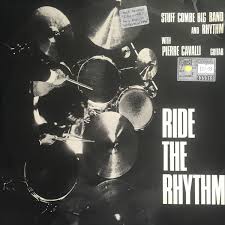
Stuff Combe was born Etienne Stephen Jean Gustave Combe in Bern, Switzerland on March 12, 1924 and initially pursued schooling in art during World War II, but ultimately decided on a career in music instead.
During the 1940s Combe played in Switzerland in the 1940s with Philippe Brun, Eddie Brunner, Ernst Hollerhagen, and Hazy Osterwald. In the 1950s he traveled extensively throughout Europe and played frequently with visiting American musicians. Near the end of the decade he recorded with Paul Kuhn and Fats Sadi. In 1957 he began playing with Kurt Edelhagen, an association that would continue into the mid-1960s.
Stuff formed his own large ensemble in Geneva, Switzerland in 1966, and the following year worked with the Radio Suisse Romande jazz band. He was Lucky Thompson’s drummer during Thompson’s 1969 Swiss tour. In the 1970s he worked with Francy Boland and Benny Bailey, and played in the western United States with Groupe Instrumental Romand.
Drummer Stuff Combe, who wrote a treatise on percussion improvisation, passed away on December 27, 1986 in Morges, Switzerland.
More Posts: bandleader,drums,history,instrumental,jazz,music
Daily Dose Of Jazz…
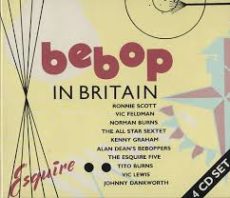
Norman Burns was born in London, England on March 11, 1920. Closely associated with the pianist George Shearing, together they worked the West End nightclub circuit in the mid 1940s, before Shearing made his fame and fortune in the USA.
Though he recorded with Alan Dean Beboppers and others in 1948, he never was a bop musician. He was a regular figure on the modern jazz scene and from 1951, he led a quintet whose format and repertoire were based on the successful George Shearing Quintet formula. From the time of their first gig they were an instant hit and for two and a half years the quintet toured the UK jazz venues with great success. They added vocalists Eileen Draper and Johnny Green in 1954 but the group disbanded in 1955.
Esquire decided to record the quintet in 1952 by which time a number of personnel changes had taken place. Victor Feldman, the highest profile jazz musician working with the group had left prior to the recordings. A later move to Australia, saw drummer Norman Burns residing for many years until he passed away in June 1994.
More Posts: bandleader,drums,history,instrumental,jazz,music
Daily Dose Of Jazz…
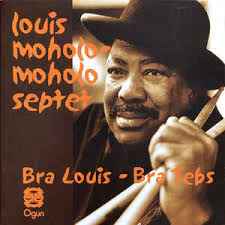
Louis Tebogo Moholo was born on March 10, 1940 in Cape Town, South Africa. He formed The Blue Notes with Chris McGregor, Johnny Dyani, Nikele Moyake, Mongezi Feza and Dudu Pukwana, and at the age of twenty-four, emigrated to Europe with them. He eventually settled in London, England where he formed part of a South African exile community that made an important contribution to British jazz.
In 1966, he toured Buenos Aires, Argentina, where he performed at the Theatron with Steve Lacy, Johnny Dyani and Enrico Rava and recorded the album The Forest and the Zoo with the same musicians. During the 1970s he was a member of the Brotherhood of Breath, a big band comprising several South African exiles and leading musicians of the British free jazz scene in the 1970s. He is the founder of Viva la Black and The Dedication Orchestra.
His first album under his own name, Spirits Rejoice on Ogun Records, is considered a classic example of the combination of British and South African players. In the early 1970s, Moholo was also a member of the afro-rock band Assagai.
He has played with, among others, Derek Bailey, Steve Lacy, Evan Parker, Enrico Rava, Roswell Rudd, Irène Schweizer, Cecil Taylor, John Tchicai, Archie Shepp, Peter Brötzmann, Mike Osborne, Keith Tippett, Elton Dean and Harry Miller.
Moholo returned to South Africa in September 2005, performing with George Lewis at the UNYAZI Festival of Electronic Music in Johannesburg, South Africa. Now going by the name Louis Moholo-Moholo because the name is more ethnically authentic, the drummer continues to perform and record.
More Posts: bandleader,drums,instrumental,jazz,jistory,music
Three Wishes
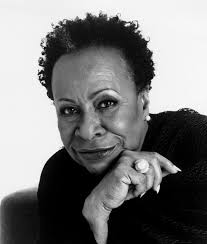
Speaking with Betty Carter, Baroness Pannonica inquired as to what she would wish for if given three and she responded by telling her:
- “Health. Without that you don’t have anything.”
- “To be recognized as an individual all the way.”
- “Happiness for my son.”
*Excerpt from Three Wishes: An Intimate Look at Jazz Greats ~ Compiled and Photographed by Pannonica de Koenigswarter

More Posts: baroness,history,instrumental,jazz,music,pannonica,three,vocal,wishes