

Daily Dose Of Jazz…
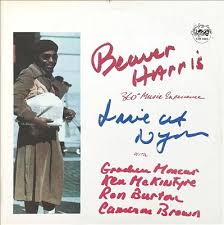
Beaver Harris was born William Godvin Harris on April 20, 1936 in Pittsburgh, Pennsylvania. Coming from an athletic family, he played baseball as a teenager for the Kansas City Monarchs, which was part of the Negro American League, and was scouted by the Brooklyn Dodgers and New York Giants.
After his Army service, Beaver began playing drums. Moving in 1963 to New York City and was encouraged to pursue a musical career by Max Roach. The city did him quite well as he worked and/or toured with Marion Brown, Dexter Gordon, Albert Ayler, Joe Henderson, Freddie Hubbard, Clifford Jordan, Howard Johnson, Sheila Jordan, Lee Konitz, Thelonious Monk, Roswell Rudd, Sonny Rollins, McCoy Tyner, Sonny Stitt, Clark Terry, Chet Baker, Doc Cheatham and Larry Coryell among other musicians.
Harris founded a world music band calling it the 360 Degree Music Experience. The band included Buster Williams, Hamiet Bluiett, Don Pullen, Jimmy Garrison, Ron Carter, Ricky Ford, and many others.
Drummer Beaver Harris, who worked extensively with Archie Shepp, died of prostate cancer in New York City at the age of 55 on December 22, 1991.
More Posts: bandleader,drums,history,instrumental,jazz,music
Daily Dose Of Jazz…
Jan Hammer was born in Prague, Czechoslovakia on April 17, 1948 to a mother who was a well-known Czech singer, and his doctor father who worked his way through school playing vibraphone and bass guitar. He began playing the piano at the age of four with formal instruction starting two years later. He aspired to follow his father into medicine until a family friend convinced him to develop his musical talents instead.
Forming a jazz trio in high school, he performed and recorded throughout Eastern Europe at the age of fourteen. Upon entrance to the Prague Academy of Musical Arts, he completed many compulsory classes including harmony, counterpoint, music history, and classical composition. He moved to the United States and resolved to become a citizen after receiving a scholarship at Berklee School of Music in Boston, Massachusetts. Upon completion of his studies, Jan spent a year touring with Sarah Vaughan, recorded with Elvin Jones and Jeremy Steig, then moved to New York City in 1971 and joined the original lineup of the Mahavishnu Orchestra.
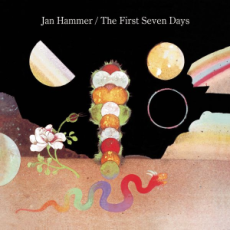
Though he previously recorded as a leader and sideman, his debut solo album, The First Seven Days, dropped in 1975. He formed the Jan Hammer Group in 1976 to support the album tour, which received good reviews from both jazz and rock critics. During the mid 70s to early 80s he recorded and played with Joni Mitchell, Billy Cobham, Santana, Tommy Bolin, Harvey Mason and Stanley Clarke.
Returning to solo work he recorded an album in 1978, formed a new band, known as Hammer, and wrote theme song for a British television series. He formed Schon & Hammer, played benefit concerts, and has received three Grammys and an Emmy nomination. By the Nineties and well into the new millennium, he continued to score and compose for film and television. In 2018 he released his first album of new material in over 10 years: Seasons – Part 1.
Keyboardist, drummer, composer, and record producer Jan Hammer continues to produce and perform.
More Posts: bandleader,composer,drums,history,instrumental,jazz,keyboard,music,producer,synthesizer
DAVE STRYKER TRIO WITH WARREN WOLF
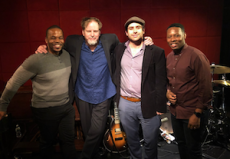
Dave Stryker – Guitar | Warren Wolf – Vibes | Jared Gold – Organ | McClenty Hunter – Drums
Whether you’ve heard guitarist Dave Stryker leading his own group (with 30 CD’s as a leader to date), or as a featured sideman with Stanley Turrentine, Jack McDuff, and many others, you know why the Village Voice calls him “one of the most distinctive guitarists to come along in recent years.” Hot House magazine awarded him Best Guitarist Fans Decision for 2017. He was recently voted once again as one of the top Jazz Guitarists in the 2019 Downbeat Critics and Readers Polls for the 10th time.
Warren Wolfis a multi-instrumentalist from Baltimore, MD. From the young age of three years old, Warren has been trained on the Vibraphone/Marimba, Drums, and Piano. Under the guidance of his father Warren Wolf Sr., Warren has a deep background in all genres of music. Vibraphonist Warren Wolf is one of the hardest swinging virtuosos in all of modern music.
***Fees Apply To All Tickets
More Posts: adventure,club,drums,genius,guitar,jazz,music,organ,preserving,travel,vibraphone
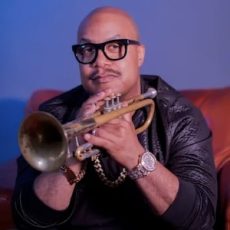
NICHOLAS PAYTON TRIO
Nicholas Payton – trumpet, piano & keyboards | Peter Washington – bass | Kenny Washington – drums
“Payton’s genius virtuosity captivated both faithful fans and anyone in the NPR crowd just discovering his music for the first time. – NPR
Multi-instrumentalist Nicholas Payton reunites the trio with bassist Peter Washington and drummer Kenny Washington that recorded his acclaimed Smoke live album Live Relaxin’ with Nick. A multi-instrumental virtuoso from New Orleans, Payton is a master trumpeter (and pianist) who brings insight, inspiration, and passion to a wide spectrum of Black American Music. Over the years, he has recorded and performed with Wynton Marsalis, Dr. Michael White, Christian McBride, Joshua Redman, Roy Hargrove, Doc Cheatham, and Joe Henderson, among many others, and is widely considered one of the most important artists of our time.
In a review, the Chicago Tribune states, “No descriptive label or category could be affixed to Payton’s solos, which were as brashly original as they were technically imposing.”
More Posts: adventure,bass,club,drums,genius,jazz,music,piano,preserving,restaurant,travel,trumpet
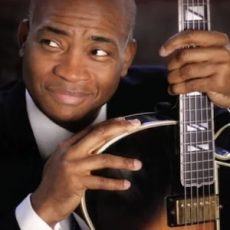
RUSSELL MALONE QUARTET
Russell Malone – guitar | Rick Germanson – piano | Vincent DuPont – drums | Neal Smith – drums
“Russell Malone has the storytelling skills of a great singer, perhaps a legacy of his many years with Harry Connick, Jr. and Diana Krall. – The Times (UK)
Guitar master Russell Malone leads his popular quartet with pianist Rick Germanson, bassist Vincent Dupont, and drummer Neal Smith. Malone is a musician deeply rooted in the blues and bebop, and his soulfully swinging approach is just one of many reasons why he is so popular. Chicago Tribune states, “Though he spikes his solos with occasional running lines, it’s gently rolled chords and lush sequences of harmonies that ultimately define his work,” and Jazz Times describes him as “an uncommonly sensitive interpreter of ballads.”
***PLEASE NOTE: All 7PM and 9PM shows at Smoke are Dinner Shows | Fees Apply To All Tickets
More Posts: adventure,bass,club,drums,genius,guitar,jazz,music,piano,preserving,restaurant,travel