

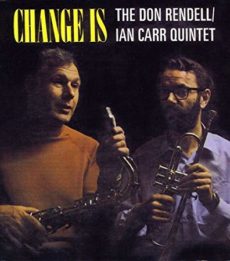
Daily Dose Of Jazz…
Donald Percy Rendell was born in Plymouth, England on March 4, 1926 and raised in London where his father, Percy, was the musical director of the D’Oyly Carte Opera Company; his mother Vera was also a musician. He attended the City of London School, to which he gained a choral half-scholarship and during school was evacuated during the Second World War to Marlborough College, where he heard jazz for the first time.
Rendell began playing the piano at the age of five but switched to saxophone in his teens. While working for Barclay’s Bank, he left to become a professional musician and began his career on alto saxophone but changed to tenor saxophone in 1943. During the rest of the 1940s, he was in the bands of George Evans and Oscar Rabin. Beginning in 1950, he spent three years in the Johnny Dankworth Septet and performed with Billie Holiday in Manchester, England, before playing in the bands of Tony Crombie and Ted Heath.
After touring in Europe with Stan Kenton, he played in Cyprus with Tony Kinsey, then Don was a member of Woody Herman’s Anglo American Herd in 1959. During the late 1950s and early Sixties, he led bands, including one with Ian Carr that lasted until 1969, one with Barbara Thompson in the 1970s, and as the sole leader in the 1980s and 1990s. In particular, the Rendell-Carr Quintet gained an international reputation, performing in France at the Antibes Festival and was the Band of the Year for three years in succession in the Melody Maker poll. He performed in festivals in England and France as well as working with Michael Garrick and Brian Priestley.
He taught at the Royal Academy of Music for three years in the early 1970s, at the Guildhall School of Music and Drama beginning in 1984 and wrote instruction books on flute and saxophone. Don Rendell, who played soprano saxophone, flute, clarinet and was also an arranger, passed away after a short illness at the age of 89 on October 20, 2015.

More Posts: arranger,author,bandleader,clarinet,educator,flute,history,instrumental,jazz,music,saxophone
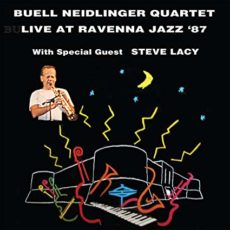
Daily Dose Of Jazz…
Buell Neidlinger was born in New York City on March 2, 1936 and raised in Westport, Connecticut, where his father ran a cargo shipping business. He played cello in his youth and began studying double bass after a music teacher recommended it to strengthen his hands. He took lessons from jazz bassist Walter Page. In his teens, suffering from a nervous breakdown, which he attributed to the pressure of being perceived as a child prodigy on cello, while institutionalized, he met jazz pianist Joe Sullivan who was in treatment for alcoholism.
Dropping out of Yale University after one year, where he had been studying orchestral music, he moved to New York City and began playing in various jazz settings. He joined Cecil Taylor’s group in 1955 and recorded extensively with Taylor’s groups with Steve Lacy and with Archie Shepp among others until 1961. He played with Herbie Nichols and was also involved with new directions in classical music.
By 1971, Buell moved to California and became the principal bassist for the Los Angeles Chamber Orchestra and was also principal bassist in the Warner Bros. studio orchestra for 30 years. He worked extensively as an orchestral and as a session bassist before becoming a music educator at the New England Conservatory and CalArts. Together with Marty Krystall, he founded K2B2 Records. The sessions he performed on as a strings player included Tony Bennett’s I Left My Heart In San Francisco and the Eagles’ Hotel California.
In 1983, he performed on the Antilles Records release Swingrass ’83. In 1997, and moved to Whidbey Island, Washington State. There, he played in a band called Buellgrass, which included fiddler Richard Greene and featured their version of bluegrass music. Neidlinger’s fourth wife, Margaret Storer, was also a bass player. They played baroque music with friends where he played cello, while she played the violin.
His final recording was The Happenings, accompanied by Howard Alden on guitar and Marty Krystall on bass clarinet and flute, released in December 2017. Bassist and cellist Buell Neidlinger, who worked prominently with iconoclastic pianist Cecil Taylor in the 1950s and ’60s, passed away on March 16, 2018.
More Posts: bandleader,bass,cello,history,instrumental,jazz,music

Daily Dose Of Jazz…
Chuck Wayne was born Charles Jagelka on February 27, 1923 in New York City to a Czechoslovakian family. As a boy, he learned banjo, mandolin, and balalaika. By the early 1940s he was playing in jazz bands on 52nd Street and after two years in the Army, he returned to New York City, joined Joe Marsala’s band, and settled in Staten Island until a 1991 move to New Jersey. He changed his musical style after hearing Charlie Parker, recording with Dizzy Gillespie in 1945. Frustrated with the difficulty of getting the sound he wanted, he considered switching to saxophone.
Wayne was a member of Woody Herman’s First Herd, the first guitarist in the George Shearing quintet, worked with Coleman Hawkins, Red Norvo, Bud Powell, Jack Teagarden, George Shearing, Lester Young, and Barbara Carroll. During the 1950s, he played with Tony Bennett, Gil Evans, Brew Moore, Zoot Sims, and George Wallington. In the Sixties, CBS hired him as a staff guitarist and for the next two decades, he played on Broadway, accompanied vocalists, and performed in guitar duos with Joe Puma and Tal Farlow.
He wrote Sonny in honor of Sonny Berman. Years later, Miles Davis took the song, renamed it Solar, and claimed he wrote it. His Butterfingers and Prospecting have been incorrectly attributed to Zoot Sims. Chuck was known for a bebop style influenced by saxophone players of his time and he developed a technique not widely adopted, and also developed a comprehensive approach to guitar chords and arpeggios.
Over the course of his career, he recorded eight albums as a leader beginning with his 1953 album The Chuck Wayne Quintet on the Progressive label. He worked as a sideman with Gil Evans, Anthony Perkins, Dick Katz, Duke Jordan, and Frank Wess, among others. Guitarist Chuck Wayne, one of the first jazz guitarists to learn bebop, passed away on July 29, 1997.
More Posts: bandleader,guitar,history,instrumental,jazz,music
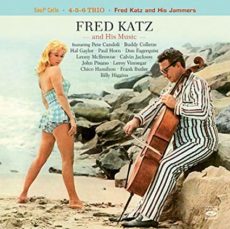
Daily Dose Of Jazz…
Frederick Katz was born on February 25, 1919 in the Williamsburg section of Brooklyn, New York City and was classically trained. He studied under Pablo Casals and performed with several symphony orchestras. He was a child prodigy on both the cello and piano and performed in public as a teenager and was drawn to the music of Manhattan nightclubs and to folk music. During World War II he conducted concerts and wrote musical revues for the U.S. Seventh Army. He was a member of the National Symphony Orchestra.
Katz was a member of drummer Chico Hamilton’s quintet, one of the most important West Coast jazz groups of the 1950s. His arco cello defined the chamber jazz focus of Chico Hamilton’s Quintet and the group quickly gained popularity. The Chico Hamilton Quintet, including Katz, appeared in the film noir The Sweet Smell of Success in 1957, starring Burt Lancaster and Tony Curtis, where Katz was described in passing as the Quintet’s primary composer. Katz and Hamilton wrote a score for the film which was ultimately rejected in favor of one by Elmer Bernstein.
As a leader Fred recorded several albums, wrote and conducted the arrangements for singer Carmen McRae’s 1958 album Carmen For Cool Ones, and recorded with Dorothy Ashby, Pete Rugolo, Ken Nordine and Paul Horn. He scored nineteen films and television shows including A Bucket of Blood, The Wasp Woman, Creature from the Haunted Sea and The Little Shop of Horrors. Later in his career, Katz became a professor of ethnic music in the Anthropology Department at California State University, Fullerton and California State University, Northridge, where he taught world music, anthropology and religion for over 30 years. One of his students was John Densmore, drummer of The Doors.
Cellist and composer Fred Katz, who was one of the earliest jazz musicians to establish the cello as a viable improvising solo instrument, passed away on September 7, 2013, in Santa Monica, California.

Daily Dose Of Jazz…
Harry Dial was born on February 17, 1907 in Birmingham, Alabama who became one of the classic drummers of the early jazz world. His specialty was keeping time behind artists known for their fun and pep. In fact, a glance at Dial’s discography is something like a partial scan of the most entertaining albums of all time, because such a list would surely include sides by two guys named Louis, Armstrong and Jordan, as well as Fats Waller and Ella Fitzgerald.
Harry was a solid, energetic drummer who pushed the beat forward without cluttering the airspace. His use of the sock cymbal and his fat, marching band snare drum sound are often imitated. He was also one of the rare breeds of singing drummers, the vocal side of his talents usually only exposed when he was in charge of the band. He was allowed to make comments on records with Fats Waller, the best example of which is the introduction to the upbeat Don’t Let It Bother You.
Dial’s career as a bandleader included a series of sides for Vocalion beginning in 1930. The group, whose recordings included the deadly “Poison,” was known as Harry Dial’s Blusicians, and included players such as banjoist Eursten Woodfork, trumpeter Shirley Clay, and the fine alto saxophonist Lester Boone. Some of this material has been reissued on the compilation Chicago 1929-1930: That’s My Stuff.
He was already recording with Armstrong around this time and began cutting tracks with Waller as a member of Fats Waller’s Rhythm before the middle of that decade. It might have taken him an additional ten years to master the art of playing the maracas since he seemed to find a way to include the delicate shakers on just about every funny style of music he played with Jordan beginning in the mid-’40s when he joined the Tympany Five.
In the late ’40s, he took another crack at recording under his own name, producing “Prince’s Boogie” for Decca with one of the earliest versions of the catchy “Diddy Wah Diddy” on the flipside. Dial liked to write as well, beginning with a song entitled “Don’t Play Me Cheap,” recorded by the famous Armstrong. His songs were also recorded by the merely infamous, a category that would not exist if it didn’t include a singer named Bea Booze, who cut Dial’s “Catchin’ as Catch Can” for Decca in 1942.
Many years later, the drummer published his All This Jazz About Jazz: The Autobiography of Harry Dial. The dapper, suave musician would have felt it important that he is most certainly not the Harry Dial who made it into the Guinness Book of World Records by claiming to have gone 78 years without bathing. Drummer Harry Dial passed away on January 25, 1987 in New York City.
More Posts: author,bandleader,drums,history,instrumental,jazz,music