

Daily Dose Of Jazz…
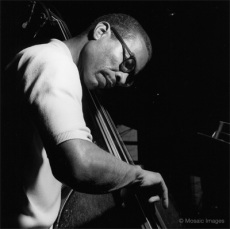
Wendell Marshall was born into a musical family on October 24, 1920 in St. Louis, Missouri. He took up the bass in emulation of and receiving his first lessons from his cousin Jimmy Blanton. He began playing professionally around his hometown in the late ‘30s and played with Lionel Hampton in ’42. Graduating from Lincoln University, he then served in the Army during World War II.
After his discharge, Marshall played and recorded with Stuff Smith, relocated to New York City and played with Mercer Ellington prior to his tenure with Duke Ellington from 1948 to 1955, appearing in several films with the orchestra.
Departing from Duke, Wendell played in pit orchestras on Broadway, freelanced with Mary Lou Williams, Art Blakey, Donald Byrd, Milt Jackson and Hank Jones among others. He was the house bassist for Prestige Records known for his rich tone, reliable sense of time and fine technique making him a popular collaborator.
It is estimated that he recorded with a prodigious list of musician with albums numbering over 150 including his own in 1955 as a leader, Wendell Marshall with the Billy Byers Orchestra. He was also a part of the Jazz Lab quintet led by Donald Byrd and Gigi Gryce.
However, by 1968 he retired from music and returned to St. Louis where he set up his own insurance business. Double bassist Wendell Marshall passed away of colon cancer on February 6, 2002 in his hometown of St. Louis.

Put A Dose In Your Pocket
More Posts: bass
Daily Dose Of Jazz…
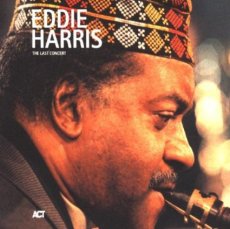
Eddie Harris was born on October 20, 1934 in Chicago, Illinois to a Cuban father and New Orleans mother. He studied music at DuSable High School, then Roosevelt University becoming proficient on piano, vibraphone and tenor saxophone and playing professionally with Gene Ammons.
After graduating and a stint in the 7th Army Band playing alongside Leo Wright, Don Ellis and Cedar Walton, he worked in New York City prior to his Chicago return. He signed with Vee Jay Records and released his debut “Exodus To Jazz” and his jazz arrangement of the theme to Exodus was so heavily played on radio, it became the first jazz record ever to be certified gold.
Throughout his career he recorded for Columbia and Atlantic Records, ventured into electric piano and Varitone saxophone mixing jazz with funk on albums like “The Electrifying Eddie Harris” and crossing into rhythm and blues markets. By 1969 he would perform with Les McCann at Montreux with an unrehearsed band that produced the seminal work Swiss Movement that became one of the best selling jazz albums ever.
In the early to mid ‘70s Harris experimented with altering instruments like his reed trumpet with a sax mouthpiece, saxobone with a trombone mouthpiece and guitorgan, a guitar/organ combination. He also forayed into singing blues, played with jazz-rock, and comic R&B consisting of mostly stand-up comedy all of which ultimately declined his popularity.
He would work with Horace Silver in the ‘80s, record regularly well into the 1990s, tour and perform in Europe and return to hard bop. His move to Los Angeles in the mid-1970s allowed him the opportunity to provide much of the music for The Bill Cosby Show.
Eddie Harris, tenor saxophonist and multi-instrumentalist and composer of “Freedom Jazz Dance” popularized by Miles Davis in the Sixties and also the tune “Listen Here”, passed away from bone cancer and kidney disease at the age of 62 on November 5, 1996.
Inspire A Young Mind
More Posts: organ,piano,saxophone,vibraphone
Daily Dose Of Jazz…
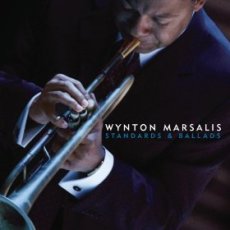
Wynton Learson Marsalis was born October 18, 1961 in New Orleans, Louisiana, the son of a jazz pianist. At an early age he exhibited an aptitude for music and by age eight he was performing traditional New Orleans music in the Fairview Baptist Church band. At 14, he performed with the New Orleans Philharmonic and during high school played with the New Orleans Symphony Brass Quintet, the New Orleans Community Concert Band, the New Orleans Youth Orchestra, the New Orleans Symphony, various jazz bands and with a local funk band, the Creators.
At age 17, Wynton was the youngest musician admitted to Tanglewood’s Berkshire Music Center where he won the school’s Harvey Shapiro Award for outstanding brass student. Moving to New York City he attended Julliard in 1979 and picked up gigs around town. He joined the Jazz Messengers led by Art Blakey in 1980 and in the years that followed he would perform with Sarah Vaughan, Dizzy Gillespie, Sweets Edison, Clark Terry, Sonny Rollins, Ron Carter, Herbie Hancock, Tony Williams and countless other jazz legends.
Marsalis has written, produced and hosted Marsalis On Music, an educational television series on jazz and classical music, National Public Radio aired the first of Marsalis’ 26-week series, titled Making the Music, was awarded a Peabody Award, has written five books, co-founded the jazz program at Lincoln Center that evolved into Jazz at Lincoln Center, opened Frederick P. Rose Hall, the first ever institution for jazz with three performance halls, recording, broadcast, rehearsal and education facilities.
Wynton Marsalis, jazz trumpeter, bandleader, composer and educator is currently the Artistic Director for Jazz at Lincoln Center and Music Director for the Jazz at Lincoln Center Orchestra. He was won nine Grammy Awards in both jazz and classical genres, and received the first ever Pulitzer Prize for Music.
Jazz Is Global – Share
More Posts: cornet,flugelhorn,flumpet,trumpet
Daily Dose Of Jazz…
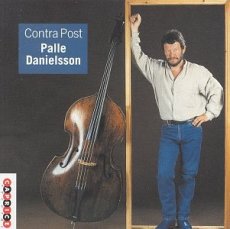
Palle Danielsson was born October 15, 1946 in Stockholm, Sweden and his childhood was an especially musical one. His first instrument he started playing at two was the harmonica and by age eight he was playing violin, which he continued to play and study for roughly five years. Around 13 he became interested in jazz music and started to play the double bass. By the time he was fifteen Palle was playing professionally.
Danielsson studied at the Stockholm Royal Academy of Music from 1962 to1966 and then began playing with Scandinavian musicians such as Eje Thelin, Bobo Stenson and Jan Garbarek and with Americans Lee Konitz and Steve Kuhn.
Perhaps most notable work was done with Keith Jarrett from 1974 to 1979 when he was a member of his European quartet. Over the years he has worked with Bill Evans, Kenny Wheeler, Geri Allen, Michel Petrucciani, Charles Lloyd, Peter Erskine, Ben Webster, George Russell and others.
Palle Danielsson has led and co-led several bands in Sweden, has recorded and released several albums and continues to perform and tour.
Take A Dose On The Road
More Posts: bass
Daily Dose Of Jazz…
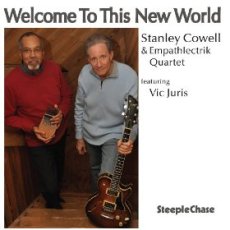
Vic Juris was born Victor E. Jurusz, Jr. on September 26, 1953 in New Jersey and started to play guitar around age 10, inspired by rock and roll legend Chuck Berry. He was self taught and played in many local rock and R&B bands around New Jersey as soon as he could.
Not long after he started playing professionally did he discover jazz and classical music and from then on it was a love affair with jazz. With an impeccable fluid approach to harmony and accompaniment, great writing style, a nice “blend” within the band, phenomenal chops, unique phrasing, advanced rhythmic ideas and concepts for improvisation Juris easily gained the respect of jazz musicians on the circuit and was not at a loss for work.
In the early 70s Vic played with Lyn Christie, made his first recordings with Eric Kloss, then joined Barry Miles working with him well into the Eighties. He recorded with Richie Cole, released his first album as a leader in the late 70s, and played with Don Patterson, Wild Bill Davis, Jimmy Smith, and Mel Torme.
He put together his own quartet in 1981, recorded for Muse and Steeplechase record labels, then became increasingly in demand as a sideman working with Bireli Lagrene, Larry Coryell, Dave Liebman, Jeanie Bryson, Gary Peacock, Judi Silvano, Lee Konitz and the list goes on.
As an educator Juris has held teaching positions at The New School for Jazz and Contemporary Music, Mason Gross School of the Arts, William Patterson and Lehigh Universities. Also a composer, his “Horizon Drive” was sampled in 1994 by Gang Starr on their Mass Appeal song. Guitarist and educator Vic Juris continued to perform, record and teach until his transition on New Year’s Eve, December 31, 2019 in Livingston, New Jersey at the age of 66.
Jazz Is Global – Share
More Posts: guitar,history,instrumental,jazz,music